Last updated 2026-08-21
TL;DR
A grease trap is a tank that slows kitchen wastewater so fats, oils, and grease float out before the public sewer. You start with local paper, not a federal license. Pull the plumbing permit and the FOG or pretreatment approval your city uses, install to that code, then pump on the local schedule and keep hauler manifests. Confirm forms with the board that inspects you.
What is a grease trap?
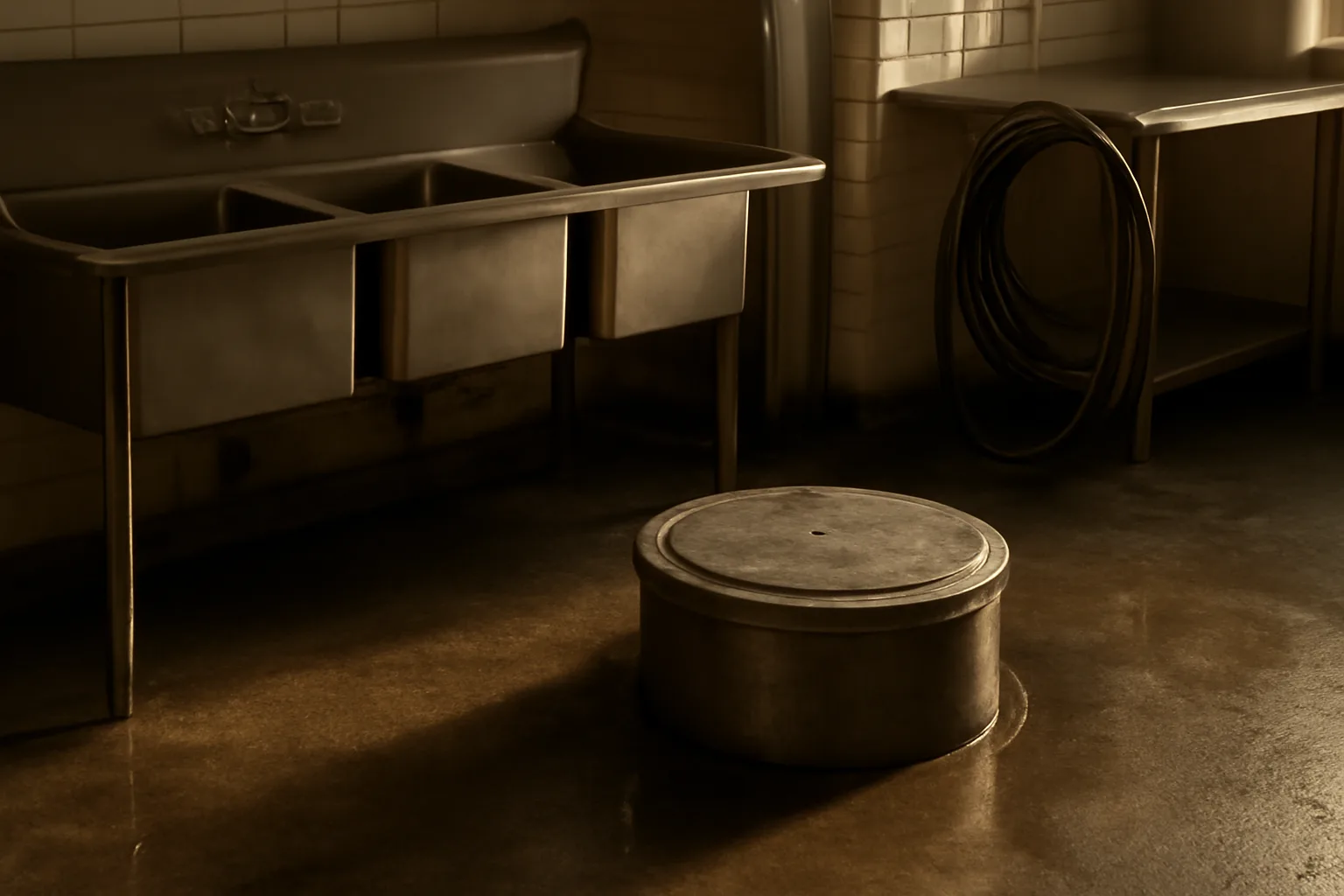
A grease trap is a plumbing interceptor that holds kitchen wastewater long enough for fats, oils, and grease (FOG) to cool and separate before the flow hits a sewer or a septic tank. Cooler FOG floats. Heavier food solids drop. The clearer middle layer leaves the unit. That is the whole job.
People mix up the words. Field crews call a small indoor box a grease trap and a large outdoor concrete tank a grease interceptor. Model codes lean toward interceptor language. The International Plumbing Code requires a grease interceptor or automatic grease removal device for fixtures with grease-laden waste in food prep areas [5]. The FDA Food Code still says grease trap. It states, "If used, a grease trap shall be located to be easily accessible for cleaning." [6]
Cities care because cooled grease sticks to pipe walls and catches rags and wipes. The line chokes. A sanitary sewer overflow can follow. Federal pretreatment rules already ban "Solid or viscous pollutants in amounts which will cause obstruction to the flow in the POTW resulting in Interference" [1]. Your local FOG ordinance is how that sentence shows up at a restaurant sink.
I treat a grease trap as a legal object as much as a box. The unit has a rated flow, a grease capacity, a lid you can open, and a paper trail. If you cannot open it and measure the grease layer, you do not have a working trap. You have a buried problem.
Typical hydromechanical units sit indoors near the three compartment sink and the pre-rinse. Gravity tanks sit outside in the yard or the alley. Both use the same physics. Retention time and temperature do the work. Hot, emulsified waste can blow through a tiny indoor unit if you tie the wrong fixtures in. Sizing and fixture routing matter more than the paint color on the lid.
A grease trap does not make grease vanish. It stores it so a licensed hauler can take it to a legal plant. That storage function is why inspectors care about depth, outlet tees, and manifests as much as the initial install.
How do you start a grease trap?
You start a grease trap by getting local approval, not by buying a tank online and hoping. No federal grease trap license exists. You talk to the plumbing official and the wastewater or pretreatment desk, you submit a unit that matches their code, you install under a permit, you pass inspection, then you put a hauler on a written schedule and keep the manifests.
Walk it in that order. First, classify the space. A cafe, commissary, school kitchen, grocery hot bar, and hospital tray line are all food service in most ordinances. A church hall that plates meals can be too. Confirm with the board. Do not trust a forum post from another state.
Second, get the two desks on the phone the same week. Plumbing reviews the interceptor listing, the venting, the sample tee, and the cleanouts. Pretreatment (or industrial waste, or FOG control) reviews the discharge, the pumping interval, and sometimes a FOG permit. In a big city those are different people. In a small town it may be one inspector with two stamps.
Third, size from fixtures and menu, not from a sales flyer. Hydromechanical ratings run in gallons per minute and pounds of grease under PDI G101 or ASME A112.14.3. Gravity tanks run in gallons. Massachusetts onsite rules, for a comparison point you can actually read, set a 1,000 gallon minimum and 24 hours of detention for grease traps on Title 5 systems [10]. Your sewered city may use fixture counts from the adopted plumbing code instead. I would not pour concrete until that number is in writing.
Fourth, file the permit set. That is usually a plumbing permit, a site sketch, the interceptor cut sheet, and sometimes a grease management plan. Some POTWs want a signed hauler contract before they sign off occupancy. Confirm the packet. Nobody here can quote your fee. Fees move.
Fifth, install, test, and open the lid for the inspector. Then start the pump log on day one. A clean empty tank with no first manifest is how first year operators fail a surprise visit.
Want a side by side of what people actually pay once the unit is in? Read Grease trap cost in California: what you'll actually pay or Grease trap cost in Alabama: what you'll actually pay. Those pages track local paper, not a national average I would not trust.
How is a grease trap different from a grease interceptor?
Most field people use grease trap for a small indoor metal box and grease interceptor for a large outdoor tank. Model codes lean toward interceptor. Buyers get hurt when they order the small box and the city wrote the large tank into the approval.
Hydromechanical grease interceptors are rated in gpm. They use baffles, and sometimes air relief, to separate FOG fast in a small footprint. Gravity grease interceptors are big. They give the waste time to cool. Automatic grease removal devices skim FOG into a separate container on a timer.
| Type | Where it usually sits | Common listing | How it is rated |
|---|---|---|---|
| Hydromechanical interceptor | Indoors, close to the sink | ASME A112.14.3 or PDI G101 | Gallons per minute and pounds of grease |
| Gravity interceptor | Outside, in the ground | IAPMO/ANSI Z1001 | Gallons of volume |
| Automatic grease removal device | Indoors | ASME A112.14.4 | Flow plus a skimmed FOG pail |
The International Plumbing Code requires a grease interceptor or automatic grease removal device to take grease-laden waste from food prep areas in restaurants, hotel kitchens, hospitals, school kitchens, bars, factory cafeterias, and clubs [5]. California's adopted plumbing code follows the same interceptor chapter structure [11]. Read the edition your city actually adopted. A 2018 code city and a 2021 code city are not the same plan check.
I would not fight the naming in an email thread. I would put the listing standard on the submittal. If the reviewer cannot find the standard on the cut sheet, they stall the permit. Unlisted welded boxes are how plan check dies.
Who actually requires a grease trap?
Your city or county requires it, using authority that starts in the Clean Water Act and the plumbing code they adopted. 33 U.S.C. 1317 is the federal pretreatment statute [4]. EPA's general pretreatment regulations sit in 40 CFR Part 403 [1][2]. Local limits and FOG ordinances are how that lands on a sink.
40 CFR 403.8 requires a pretreatment program at many POTWs with a design flow greater than 5 million gallons per day [2]. Smaller plants can be pulled in if the approval authority finds a need. EPA's introduction to that program describes a cooperative federal, state, and local setup built to protect water quality and the treatment plant [3]. Food service FOG is usually handled as a local limit or a dedicated FOG ordinance, not as a categorical industrial user standard.
Discharge to a septic system and you are in a different book. Massachusetts Title 5 is a clear example. 310 CMR 15.230 requires grease traps at restaurants, nursing homes, schools, hospitals, and other sites that can send grease, and it sets construction and pumping rules [10]. Other states have their own onsite codes. Confirm the board that signs septic permits.
Sewer agencies also write FOG control into sanitary sewer overflow programs. California's statewide sanitary sewer systems order tells enrollees to address FOG where it causes blockages [9]. That is why a California kitchen can face both a plumbing inspector and a source control inspector on the same tank.
EPA's 2004 Report to Congress on CSOs and SSOs is still the federal document people cite when they talk about how common overflows are. EPA reported a wide national range, on the order of tens of thousands of SSO events a year, with incomplete local reporting [8]. Grease shows up again and again in city blockage data. Nobody has one clean national grease-share figure I would bet a permit on. The honest move is to read your POTW's FOG findings, not a blog pie chart.
What paper do you need before you install one?
You need the application the building department actually stamps and, in many cities, a separate FOG or industrial waste form from the sewer agency. Expect a plumbing permit, a floor plan that shows the interceptor, the manufacturer cut sheet with the listing, and a riser or isometric if they ask. Some reviewers want calculations.
I also put these in the folder before I schedule a pour. A fixture schedule (three comp, prep sinks, floor sinks, wok line, can wash). A note on the dishwasher, because many codes keep high temp dishwashers out of small traps. A sample port or sample tee if pretreatment asked for one. A hauler letter if the FOG program wants proof you can get pumped. Property owner permission if you are a tenant cutting a vault in the alley.
Variable fees live on the city fee schedule. I will not invent one. Confirm with the relevant board. Same for review time. Anyone who promises you a set number of days on a FOG permit is guessing.
Operate in more than one state? Do not photocopy the first city's packet. Grease trap cost in Arizona: what you'll actually pay and Grease trap cost in Arkansas: what you'll actually pay are useful next reads because the line items change even when the physics do not.
Build a paper kit you can hand over. Cut sheets, permits, as-builts, pump contract, and a blank manifest log. GreaseTrapPath sells a $199 one-time Interceptor + Manifest Kit if you want that packet assembled. You can also make the same file with the city's own forms and a binder. The binder is what the inspector wants. The cover art is not.
How do you size a grease trap without guessing?
You size it from the code edition and the fixture load the reviewer accepts. Not from the cheapest catalog unit. Not from the last taco shop that got away with 20 gpm.
For hydromechanical units, start with the adopted plumbing code's interceptor section and the listed flow rate [5][11]. Add the fixtures that are allowed to tie in. Leave out the ones the code or the manufacturer forbids. If the reviewer uses drainage fixture units, use their table. If they use a grease production method (meals per day, seats, hours), use that and put the math on the sheet.
For gravity tanks, volume and detention time rule. Massachusetts 310 CMR 15.230 sets a 1,000 gallon minimum grease trap capacity on covered Title 5 systems [10]. It also wants at least 24 hours of detention. A sewered downtown may still want a 750 gallon or 1,000 gallon outdoor interceptor for a full restaurant. Some will accept a large indoor hydromechanical unit if the site has no yard. That is a site fight, not a blog rule.
I undersize less than I used to. A trap that is too small passes the first inspection and fails the third pump-out when the grease layer is already over the outlet. Oversizing a gravity tank can go wrong too if flow is so low the contents go septic and stink. Match the menu. A bakery is not a fried chicken line.
Get the listing number on the submittal. If the cut sheet cannot point to ASME A112.14.3, PDI G101, or IAPMO/ANSI Z1001, I would not order the unit. Plan check will ask. You will wait on a resubmittal you could have skipped.
What happens in the first year of operations?
The first year is pumping, measuring, and not lying on the log. You will have a break-in stretch where the tank is clean and the layer grows fast because the kitchen is still learning what not to send down the drain. Train dish staff in week one. Scrape plates. Dry wipe pans. Keep the trap lid accessible. Bury it under a mixer on wheels and you will skip openings, and you will get caught.
Inspect the layer yourself between hauler visits only if the lid is safe to open from grade. Some outdoor vaults are confined spaces. OSHA's permit-required confined space rule at 29 CFR 1910.146 applies when the space has those hazards [7]. I do not send a line cook into a vault. I call the hauler.
Expect at least one inspection in year one in a city with an active FOG program. They will look at the lid, the grease thickness, the outlet tee, and your manifests. They may sample. Failures are usually an over-full tank, a missing log, or a dishwasher line that skipped the interceptor.
Renewal paper is local and it is not the same as the install packet. Need the later year path in a specific state? Use a state page such as grease trap renewal in california or grease trap renewal in florida. Do not assume the year one folder is the forever folder.
I would rather over-pump in month two than explain a backup in month four. The first year is when staff habits set. A cheap skipped pump is how you meet the after-hours crew.
How often do you pump a grease trap?
You pump on the interval your ordinance or permit states, or sooner if the grease and solids hit the local trigger depth. A common onsite rule is the 25 percent rule plus a time cap. Massachusetts writes it in plain language for Title 5 grease traps: inspect monthly, and clean whenever grease is 25 percent of the effective depth, or at least every three months, whichever is sooner [10]. Many sewer FOG programs copy that idea. Some want 60 days. Some want 90. A few small indoor units get 30 days. Confirm the board. Do not borrow a neighbor's interval.
I would not buy enzyme or bacteria jugs as a substitute for pumping. A lot of ordinances ban them because they push emulsified FOG downstream. If your city allows a biological additive, it still does not replace a pump-out. The hauler still has to take the grease.
Schedule the hauler before you open, not after the first backup. Holiday weeks book out. A Friday night overflow costs more than a planned pump.
Keep every manifest. The slip should name the generator, the date, the gallons, and the disposal plant. If the driver hands you a blank, do not sign it. A signed blank is how a later audit goes badly.
Ugly access (tank under a dumpster pad, cars parked on the lid, a seized bolt) needs a fix in month one. Haulers charge for fighting the site, and inspectors notice a lid nobody has opened.
What records do inspectors actually ask for?
They ask for the permit, the last few pump manifests, and proof the interceptor in the ground matches the approved cut sheet. Some want photos of the open tank with a measuring stick. Some want a grease management plan with staff training dates. A FOG program with teeth will ask for 1 to 3 years of manifests. Confirm retention with the board. I keep three years unless the permit says longer.
Put the file where the night manager can find it. Inspectors do not wait for the owner to fly back.
Useful contents, in one binder or one cloud folder with offline copies. Approved drawing and serial number. Plumbing permit and FOG permit if issued. Hauler contract and the hauler's registration number (many cities license the pumper). Manifests in date order. Any notice of violation and the close-out letter.
Change menus or add a fryer, and you update the file and call pretreatment. A new wok line is a new load. The approved 20 gpm indoor unit from opening day may no longer match the kitchen you are running.
I have seen clean kitchens fail because the manifests lived in the owner's car. That is a paper problem, not a plumbing problem. Treat the log like a health department temperature chart. If it is not on site, it does not exist.
How much does a grease trap cost to start?
There is no honest national price. Indoor hydromechanical units cost less than outdoor concrete vaults. The tank is often the small line. Cutting a parking lot, setting a traffic-rated lid, adding a sample box, and shutting a lane for a day are the real bills. Labor and restoration swing more than the interceptor list price.
I will not invent a current fee or a typical install bid. Quotes go stale and they are local. Ask two plumbers who have passed inspection in that city, and read the fee schedule. For state-shaped cost walkthroughs, use Grease trap cost in California: what you'll actually pay and Grease trap cost in Arizona: what you'll actually pay.
Ongoing cost is pumping plus any FOG permit renewal the sewer agency charges. Pumping price tracks access, gallons, and disposal. A vault under a dumpster enclosure costs more to service than an indoor trap with a clean aisle. Budget the pump interval the permit states, not the interval you wish it stated.
Waste of money, from me: unlisted used tanks, miracle enzyme programs sold as no more pumping, and an indoor unit that the dish machine will blow out because you tied the wrong fixtures in. Spend on access and on a unit the reviewer has already accepted on paper.
Tenant buildouts have a hidden cost. If the landlord owns the outdoor interceptor, get the shared-use rules in writing. You can still be the generator on the manifest. You can still get the NOV.
What gets people fined or shut off?
An over-full interceptor, a missing manifest, an illegal bypass, and a sewer backup that traces to your lateral. Pretreatment can issue a notice of violation. The health department can freeze food service if wastewater is on the floor. The city can charge you for cleaning a main. Repeat FOG violations can escalate under the local sewer use ordinance, which sits on the 40 CFR 403 prohibition on viscous pollutants that obstruct the POTW [1].
EPA's model pretreatment ordinance is the template a lot of cities still borrow when they write inspections, enforcement, and penalties [12]. Your actual fine schedule is in the municipal code. Confirm it. I will not invent a dollar amount.
The dumbest fail is a floor sink tied around the trap, sold as mop water only, that also takes wok runoff. Inspectors dye-test. Bypass is not clever.
Shutoffs are less common on a first paper error and more common after a backup or an ignored notice. Still, do not assume you get a friendly warning forever. Keep the tank legal and the folder complete.
Grease that leaves your control and hits a public main is no longer a private plumbing dispute. You are in the sewer ordinance. That is a worse room.
Do you need a hauler license to start a kitchen grease trap?
No. The kitchen is the generator. The pumper is the hauler. You need the kitchen-side permits. The company that sucks the tank needs whatever septage or grease hauler registration the state and city require. Ask to see it before they pump. If they cannot show a registration, find another truck.
Some cities also register generators and issue a FOG discharge permit number you put on every manifest. That is still not a national license. It is a local account number.
Food trucks and commissaries are messy. The truck may need a commissary agreement that names the interceptor at the home base. The health department cares. Confirm both desks. A trap on a trailer that never gets pumped is a rolling violation.
Expand to another state later and you restart the paper. grease trap renewal in georgia and grease trap renewal in alabama show how renewal paths diverge once you are past opening day. The physics stay the same. The forms do not.
Where do the rules live if there is no national license?
They live in three stacks. The adopted plumbing code (often the IPC or a state plumbing code) tells you when an interceptor is required and how it is built [5][11]. The sewer use ordinance and FOG program tell you how you operate, pump, and report, under the federal pretreatment frame in 40 CFR 403 [1][2][3]. Onsite rules like Title 5 apply if you are not on a public sewer [10]. OSHA covers the vault entry [7]. The FDA Food Code covers access if your health department adopted that language [6].
That is the whole map. No U.S. grease trap license bureau exists. Anyone selling you a national card is selling a course, not a credential the inspector will stamp.
Clean Water Act pretreatment is the federal backbone, not a kitchen permit desk [4]. EPA's pretreatment introduction is still the readable explainer for how local programs got their job [3]. After that, you are in municipal code and the adopted plumbing edition. Print those two. Leave the national myth websites closed.
Want a single packet of forms and a manifest log you can fill? The Interceptor + Manifest Kit is on /start. GreaseTrapPath is an independent publisher, not a law firm and not a service company. We do not pull permits and we do not promise approval times. Confirm every variable fact with the board that will stand on your lid.
Frequently asked questions
What is grease trap?
A grease trap is a small interceptor on a kitchen drain that slows wastewater so fats, oils, and grease separate before the sewer or septic tank. FOG floats, solids settle, and clearer water leaves the middle. Cities require them at food service sites because grease blocks sewers. Confirm the local name. Some codes say interceptor instead.
How do you start grease trap?
Start with the plumbing desk and the wastewater or FOG desk, not with a tank purchase. File the local permit set, submit a listed unit that matches the adopted code, install under inspection, then put a registered hauler on the written pump interval and keep manifests. There is no federal grease trap license. Confirm fees and forms with the board that inspects you.
Is there a federal grease trap license?
No. 40 CFR Part 403 frames pretreatment at the POTW. It does not issue a kitchen grease trap card. Your plumbing permit and any local FOG or industrial waste permit are the real paper. A course certificate is not a substitute. Ask the city which form they stamp before you spend money on training that the inspector will not accept.
Is a grease trap the same as a grease interceptor?
In the field, trap usually means a small indoor box and interceptor means a large outdoor tank. Model plumbing codes lean toward interceptor language for both. Hydromechanical units are rated in gpm. Gravity tanks are rated in gallons. Submit the listing standard the reviewer uses. Fighting the name in email wastes weeks.
Can I install a 20 gpm under sink unit in every city?
No. Many cities will fail a small indoor unit if the menu, dishwasher routing, or adopted code wants a gravity tank. Size from the local interceptor chapter and the accepted fixture method. A unit that passed in another county can still fail plan check here. Get the gpm or gallon number in writing before you order.
Who is allowed to pump a grease trap?
A registered grease or septage hauler, not the night crew with a wet vac. The kitchen is the generator. The truck is the hauler. Ask for the hauler's local or state registration before the first pump. Keep the manifest that names you, the date, the gallons, and the disposal plant. Do not sign a blank slip.
Are outdoor grease trap vaults confined spaces?
They can be. OSHA 29 CFR 1910.146 covers permit-required confined spaces when the hazards line up. I do not send kitchen staff into a vault to scrape walls. Call the hauler and stay out of the hole. Indoor lids you can open from a finished floor are a different, safer check if the unit was built for that.
What is a FOG discharge permit?
It is a local wastewater account some POTWs issue to food service generators. It is not a national license. It may set your pump interval, reporting, and sample port rules. Some cities fold FOG into a broader industrial waste permit. Confirm the form name with pretreatment. Plumbing approval alone may not finish the paper.
How long should I keep grease trap pump manifests?
Keep them as long as the FOG permit or sewer ordinance states. If the board is silent, I keep three years on site. Inspectors often ask for the last several slips plus the approved cut sheet. Put the file where a manager can hand it over without calling the owner. If it is not on site, it does not count.
Can enzymes replace pumping a grease trap?
Treat them as a waste of money unless your ordinance clearly allows them, and even then they do not replace a pump-out. Many FOG programs ban additives because they emulsify grease and send it downstream. The hauler still has to remove the stored FOG. If a vendor promises no more pumping, that pitch is the red flag.
What if my kitchen is on a septic system, not a city sewer?
You still need a grease trap if the onsite code says so. Massachusetts Title 5 is a clear published example: 310 CMR 15.230 sets a 1,000 gallon minimum on covered systems and a cleanout at 25 percent or every three months, whichever is sooner. Other states write their own onsite books. Confirm with the board that signs septic permits.
Do food trucks need a grease trap?
Often the commissary does, and the truck needs a written tie to that interceptor. Health departments care about where the wastewater actually goes. A trailer tank that never gets legally dumped is a problem. Confirm both the mobile food permit desk and the commissary's FOG or plumbing file before you advertise a menu that fries.
Who inspects a grease trap after opening?
Plumbing may inspect the install. Pretreatment or FOG control inspects pumping, thickness, and manifests. Health may look if wastewater hits the kitchen floor. In a small town one person may wear two hats. Ask who will open the lid in year one and keep that person's checklist in the binder.
Sources
- eCFR 40 CFR 403.5 National pretreatment standards: Prohibited discharges: Federal rules prohibit solid or viscous pollutants in amounts that will cause obstruction to POTW flow resulting in Interference.
- eCFR 40 CFR 403.8 Pretreatment Program Requirements: POTWs with design flow greater than 5 million gallons per day and industrial users must have pretreatment programs, with smaller plants included when required.
- U.S. EPA Introduction to the National Pretreatment Program (EPA-833-B-11-001): The National Pretreatment Program is a cooperative federal, state, and local program established to protect water quality and POTWs.
- 33 U.S.C. § 1317 Toxic and pretreatment effluent standards: The Clean Water Act authorizes federal pretreatment effluent standards administered through EPA and approved state and local programs.
- International Plumbing Code 2021 Chapter 10 Traps, Interceptors and Separators: IPC Chapter 10 requires grease interceptors or automatic grease removal devices for grease-laden waste from food preparation areas.
- U.S. FDA Food Code 2022, section 5-402.12 Grease Trap: If used, a grease trap shall be located to be easily accessible for cleaning.
- OSHA 29 CFR 1910.146 Permit-required confined spaces: Outdoor interceptor vaults can fall under OSHA permit-required confined space rules when the listed hazards are present.
- U.S. EPA Report to Congress: Impacts and Control of CSOs and SSOs (EPA 833-R-04-001): EPA reported a wide national range of sanitary sewer overflow events per year and incomplete reporting across communities.
- California State Water Resources Control Board Order WQ 2022-0103-DWQ: California's statewide sanitary sewer systems order requires enrollees to address FOG where it contributes to blockages and overflows.
- Massachusetts 310 CMR 15.00 Title 5 (grease traps at 15.230): Title 5 requires grease traps at restaurants and similar facilities, with a 1,000 gallon minimum, 24-hour detention, monthly inspection, and cleaning at 25 percent depth or every three months, whichever is sooner.
- California Plumbing Code 2022 Chapter 10 Traps and Interceptors: California's adopted plumbing code contains the interceptor and trap chapter used in local plan check for grease-laden waste.
- U.S. EPA Model Pretreatment Ordinance: EPA's model ordinance is the template many local sewer use codes still use for inspections, enforcement, and penalty structure.