Last updated 2026-08-18
TL;DR
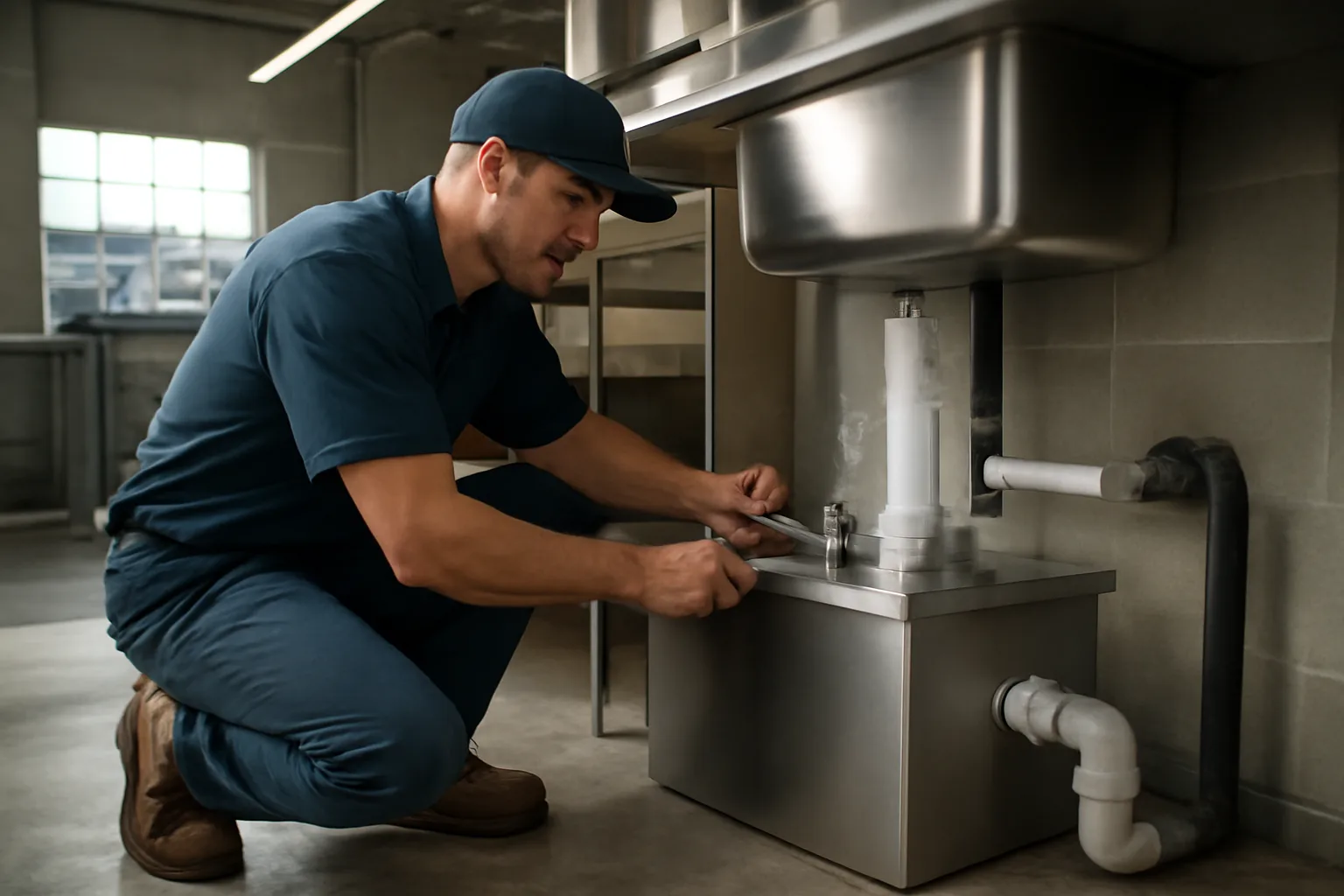
A grease trap in Arizona costs about $300 to $8,500 to install, depending on size and whether it's an indoor unit or an underground tank. Pumping runs $150 to $400 per visit. There's no state grease trap license, but your city, your county health department, and ADEQ pretreatment rules each have paperwork you file before you open.
How much does a grease trap cost in Arizona?
Plan on $300 to $1,500 for a small indoor hydromechanical unit (25 to 100 gallons per minute), $1,500 to $4,000 for a mid-range unit (100 to 500 GPM), and $4,000 to $8,500 or more for a large underground gravity interceptor. Labor and excavation are the wild card. A concrete or fiberglass in-ground tank can add $1,500 to $3,000 in installation labor in the Phoenix metro area alone, and some Maricopa County soils need extra shoring before you can drop a tank.
Here's what you're actually buying.
| Component | Typical Arizona cost range |
|---|---|
| Small hydromechanical unit (25 to 50 GPM) | $300, $800 |
| Mid hydromechanical unit (50 to 100 GPM) | $800, $1,500 |
| Large hydromechanical unit (100 to 500 GPM) | $1,500, $3,500 |
| Gravity grease interceptor (1,000+ gal tank) | $3,500, $8,500+ |
| Installation labor (indoor) | $200, $600 |
| Installation labor (outdoor/underground) | $1,200, $3,500 |
| City permit fee | $50, $300 |
| First pump-out and manifest | $150, $400 |
These ranges come from published plumbing supply pricing and the EPA's pretreatment program documentation on interceptor sizing [2]. No Arizona agency publishes an official installation cost registry, so treat these as real-market estimates. Confirm with at least three local contractors before you sign anything.
Arizona sits below California on labor rates and above Utah and New Mexico on average. See grease trap cost in California for how those numbers change once you cross the state line.
What drives the price up or down in Arizona specifically?
A few things push Arizona costs off the national average.
Start with the sewer ordinances. Phoenix and Tucson both run strict local rules. The City of Phoenix Water Services requires any food service establishment on the municipal sewer to hold a wastewater discharge permit, and that permit ties your interceptor to minimum sizing standards drawn from the Uniform Plumbing Code [5]. Size the unit too small and you pay to replace it, which costs far more than getting it right the first time.
Water is expensive here. Operators who pick water-cooled or flow-heavy equipment often underestimate how the ongoing water bill lands on total cost of ownership. That's not a trap cost exactly, but it shapes the unit you should choose.
Then there's the heat. An outdoor unit baking in 115-degree Phoenix summer degrades grease differently than one sitting in a Chicago basement. Local pumping companies sometimes recommend shorter service intervals in summer, which raises your annual pumping bill above what a cooler state would cost you. Nobody has solid statewide data on exactly how much the heat shortens intervals. The firsthand accounts I've read from Arizona contractors point to roughly one extra pump cycle per year for heavily used kitchens through a Maricopa County summer.
Maricopa County Environmental Services and Pima County Regional Wastewater Reclamation each run their own pretreatment inspection programs on top of ADEQ rules [4]. That means multiple inspection visits and fees that rural-county operators simply don't face.
Do you need a license for a grease trap in Arizona?
No. Arizona does not issue a state-level grease trap license. There's no ADEQ form that certifies you as a "grease trap operator." That's the good news.
The paperwork you do need breaks into three buckets.
1. Local wastewater discharge permit. In Phoenix, Tempe, Mesa, Scottsdale, Tucson, or any city with its own sewer system, you need the city's industrial or food service pretreatment permit before your kitchen opens. Phoenix, for example, requires a Significant Industrial User permit or a Minor Industrial User permit depending on your discharge volume [5]. Fees vary by city. Pull Phoenix's current fee schedule straight from Water Services because the numbers change.
2. ADEQ pretreatment program compliance. Arizona's pretreatment rules sit under ADEQ's Water Quality Division and are grounded in 40 CFR Part 403, the federal general pretreatment regulations [2]. ADEQ delegates most enforcement to the Publicly Owned Treatment Works (POTW) in your area, so your city sewer authority is usually the front-line inspector. ADEQ still sets the floor, and in an area without a locally approved pretreatment program, you deal with ADEQ directly.
3. Health department permit. Maricopa County Environmental Services and the Arizona Department of Health Services both inspect food service facilities [4][6]. The grease interceptor is part of that inspection. If the unit isn't installed or sized right, you fail the food facility inspection and you can't open.
No license, then, but three separate permit tracks. Each has its own form, timeline, and fee. Run them in parallel, not in sequence, or you'll add weeks to your opening date.
How long does grease trap permitting and installation take in Arizona?
Budget 4 to 12 weeks from permit application to first legal operation. The spread depends entirely on which city you're in and whether your contractor pulls permits correctly the first time.
Here's a realistic Phoenix sequence.
- Week 1-2: Submit the building/plumbing permit application to City of Phoenix Development Services. Online submission runs through the city's SHAPE PHX / ProjectDox system.
- Week 2-4: Plan review for new food service plumbing. Phoenix's standard review has ranged from 10 to 21 business days depending on intake volume. Confirm the current queue when you apply.
- Week 4-6: Install the unit once permits are issued. Indoor hydromechanical installs take 1 to 2 days. Underground interceptors with excavation take 3 to 7 days.
- Week 5-7: Plumbing inspection and sign-off.
- Week 6-8: Submit or finalize the wastewater discharge permit through Phoenix Water Services.
- Week 8-12: Health department pre-opening inspection.
Tucson runs a similar cadence, but Pima County's review times differ. Check Pima County Development Services directly [8]. Rural counties like Yavapai or Coconino often move faster because there's less volume in the queue.
The real bottleneck is sizing. If your interceptor size gets flagged during plan review, you may resubmit drawings, and that adds 2 to 4 weeks. Get a licensed Arizona plumbing contractor involved before you submit, not after the comment letter lands.
What are the ongoing grease trap pumping costs in Arizona?
Pumping is your biggest recurring cost. Most Arizona municipalities require you to pump often enough to keep the grease cap below 25% of the trap's working depth, which for a busy restaurant means every 30 to 90 days [2]. Some cities write a specific interval into your pretreatment permit.
Pumping in Phoenix and Tucson generally runs $150 to $400 per visit for a standard hydromechanical unit, and $250 to $600 for a large in-ground interceptor that needs a vacuum truck. Those figures come from Arizona operator forums and contractor price lists, not a single official source, so get three quotes from licensed Arizona grease haulers.
Every pump-out needs a waste manifest. Arizona tracks grease waste disposal under its liquid waste rules, and your hauler is required to provide a manifest showing where the grease went [9]. Keep those manifests. Health inspectors and sewer authority inspectors ask for them, sometimes going back two or three years.
Run the math on a mid-size restaurant on a 60-day cycle: 6 visits at $200 to $350 each equals $1,200 to $2,100 a year in hauling fees alone. That's before any enzyme additives or cleaning products, which most experienced operators treat as optional at best.
What size grease trap does Arizona require?
Arizona adopts the Uniform Plumbing Code, and local jurisdictions amend it. The UPC sizing method ties interceptor capacity to the total fixture unit count of your kitchen, meaning the number and flow rate of fixtures draining into the interceptor.
A small cafe with two compartment sinks and a dishwasher often satisfies the math with a 20 to 35 GPM hydromechanical unit. A full-service restaurant with floor drains, multiple prep sinks, and a commercial dishwasher typically needs 50 to 100 GPM minimum. Some cities push that to a 1,000-gallon gravity interceptor above a certain seat count.
Phoenix Water Services has historically required gravity interceptors for new-construction food service above a set threshold, though that threshold changes. Confirm the current standard with the city's pretreatment coordinator [5]. Don't trust what the plumber who did your landlord's build-out four years ago remembers. The rules have tightened.
Mesa and Scottsdale follow Maricopa County's baseline with their own amendments. Tempe has been busy updating its sewer use ordinance in recent years. Each city's current version is the one that governs your job.
How do Arizona grease trap costs compare to neighboring states?
Here's how Arizona stacks up against its regional neighbors on the main cost inputs. These are real-market ranges, not official government figures.
| State | Small unit install (materials + labor) | Avg pump-out cost | Key regulatory body |
|---|---|---|---|
| Arizona | $500, $4,000 | $150, $400 | ADEQ + local POTW |
| California | $800, $6,000+ | $200, $500 | State Water Board + local agency |
| Colorado | $450, $3,500 | $130, $350 | CDPHE + local [12] |
| Nevada | $500, $4,000 | $150, $380 | NDEP + county |
California skews higher mostly because of labor rates and stricter local amendments in places like Los Angeles County and the Bay Area. Arizona is roughly even with Nevada and a bit above Colorado on installation, though Phoenix's pump-out market is competitive given how many food service operators crowd the metro.
Deciding between Arizona and a border state? The regulatory overhead here is real but not unusually heavy next to California's. See grease trap cost in California and grease trap cost in Colorado for those state-by-state breakdowns.
What permits and records do you need to keep for Arizona grease traps?
Arizona inspectors and sewer authority auditors expect a paper trail. Keep this exact set of documents in a physical binder on-site and in a digital backup.
1. Your local wastewater discharge or pretreatment permit (renewed on your city's schedule, often annually). 2. Your food facility license from the county health department [6]. 3. Every pump-out manifest, going back to opening day. Arizona haulers are required to produce them, but you need your own copy. 4. Your interceptor installation permit and signed-off inspection card. 5. Any sizing calculation worksheets your engineer or plumber submitted during plan review. 6. A maintenance log with dates of self-cleaning (if applicable) and any repairs.
Some cities are moving to online pretreatment reporting portals where you log pump-outs electronically. Phoenix Water Services has been expanding its online compliance tools. Keep paper backup anyway. If the portal goes down during an inspection, the inspector doesn't pause.
Building this binder from scratch can feel like its own project. GreaseTrapPath's Interceptor + Manifest Kit ($199 one-time) assembles the core template documents for this workflow. You can also build it yourself with the agency forms linked in the citations below.
What happens if you skip or delay grease trap compliance in Arizona?
Consequences escalate fast. At the light end, a health department inspector flags an un-installed or undersized interceptor and issues a correction notice with a deadline, usually 15 to 30 days.
Miss that deadline, or let a sewer authority inspector trace grease in the municipal main back to your kitchen, and enforcement gets heavier. Pretreatment violations under ADEQ's water quality program can bring compliance orders, and when the city is the enforcement arm, fines in Phoenix and Tucson have historically been assessed per day of non-compliance. A.R.S. Section 49-261 authorizes ADEQ to assess civil penalties of up to $25,000 per day per violation for significant water quality violations [13].
That $25,000 ceiling is for egregious cases, not a missed manifest. But the day-rate structure means costs compound quietly. Published Arizona enforcement records describe routine interceptor citations that ballooned into multi-thousand-dollar penalties because the operator ignored the first notice.
Here's the more expensive problem in practice: a blocked main sewer line caused by grease from your restaurant can trigger a direct civil liability claim from the utility. That's a different animal from the regulatory fine, and often a bigger bill.
How do you find a licensed grease trap contractor in Arizona?
Arizona requires plumbing contractors to hold an ROC (Registrar of Contractors) license. The classification for grease trap work is typically the C-37 (Plumbing) license [14]. You can verify any contractor's license status for free on the Arizona Registrar of Contractors website.
For pumping and hauling, the contractor needs to be registered as a liquid waste hauler under ADEQ's rules [9]. Ask to see both credentials before you hire. Plenty of operations use one plumber for installation and a separate company for ongoing pumping, which is fine, but make sure the pumping company can actually issue a compliant manifest.
Get three bids. That's the floor, not the target. The gap between the lowest and highest bid I've seen described for the same Phoenix installation job runs more than 100%, mostly because one contractor includes permit pull fees and another doesn't. Make every bid spell out materials, labor, permit fees, first pump-out, and who files the pretreatment permit paperwork.
For context on nearby markets, grease trap cost in Colorado and grease trap cost in Idaho are useful comparisons if you're weighing several states.
What's the cheapest legal path to grease trap compliance in Arizona?
The cheapest path isn't always the cheapest total path. A $300 passive hydromechanical unit that misses your city's sizing requirement costs you a replacement plus re-inspection plus lost time. So here's what cheap-and-legal actually looks like.
For a small coffee shop or low-volume prep kitchen: confirm with your city's pretreatment coordinator whether you need an interceptor at all. Some jurisdictions exempt facilities below a certain fixture count, or those serving only non-grease-producing food. If you qualify, get the exemption in writing.
If you do need one, the lowest-total-cost path is a properly sized indoor hydromechanical unit from a listed plumbing manufacturer, installed by an ROC-licensed C-37 contractor, with the permit pulled before work starts. Budget $800 to $2,000 installed for a small unit in Phoenix, permit fee included.
Don't skip the permit to save $50 to $200. A stop-work order or a failed health inspection reopening delay swamps that savings in a single day.
GreaseTrapPath has a full kit for the paper side at /start, covering the manifest and interceptor documentation templates. Use it or build your own, but don't skip the documentation.
Frequently asked questions
Do you need a license for a grease trap in Arizona?
Arizona has no state-issued grease trap operator license. You need three things instead: a local wastewater discharge or pretreatment permit from your city or county sewer authority, compliance with ADEQ's pretreatment rules under 40 CFR Part 403, and a county health department food facility permit that includes grease interceptor inspection. All three run on separate timelines, so start them in parallel.
How much does grease trap installation cost in Arizona?
Small indoor hydromechanical units (25 to 50 GPM) run $300 to $800 in materials plus $200 to $600 in labor. Mid-size units run $800 to $3,500 installed. Underground gravity interceptors with excavation can reach $6,000 to $8,500 or more. Permit fees add $50 to $300 depending on the city. Get three bids from ROC-licensed C-37 plumbing contractors before committing.
How long does grease trap permitting take in Arizona?
In Phoenix and Tucson, expect 4 to 12 weeks from permit application to final inspection sign-off. Plan review alone can take 10 to 21 business days in Phoenix. Rural counties move faster. The main delay is a sizing or drawing error that triggers a resubmission. Hire a licensed plumber before submitting, not after you get a comment letter.
How often do you have to pump a grease trap in Arizona?
Most Arizona municipalities require pumping when the grease cap reaches 25% of the trap's working depth, which usually means every 30 to 90 days for a busy restaurant. Some pretreatment permits specify a fixed interval. In Phoenix summers, high heat can speed grease accumulation, pushing some operators toward more frequent service. Your pumping contractor can help calibrate the schedule based on actual inspection results.
What does grease trap pumping cost in Arizona?
Pumping a standard indoor hydromechanical unit in Phoenix or Tucson typically runs $150 to $400 per visit. Large in-ground interceptors requiring a vacuum truck run $250 to $600. Annual pumping cost for a mid-size restaurant on a 60-day cycle is roughly $1,200 to $2,100. Prices vary by contractor and location; get quotes from at least two licensed Arizona liquid waste haulers.
Does ADEQ regulate grease traps in Arizona?
Yes. ADEQ's Water Quality Division oversees Arizona's pretreatment program under authority delegated from EPA's 40 CFR Part 403. In most metro areas, ADEQ delegates day-to-day enforcement to the local Publicly Owned Treatment Works, so Phoenix, Tucson, Mesa, and other cities run their own pretreatment compliance programs. If you're outside a city with an approved program, you may deal with ADEQ directly.
What size grease trap is required in Arizona?
Arizona adopts the Uniform Plumbing Code for sizing, tying interceptor capacity to the fixture unit count of your kitchen. A small cafe may qualify for a 20 to 35 GPM unit. A full-service restaurant typically needs 50 to 100 GPM minimum, and Phoenix has historically required gravity interceptors for larger operations. Confirm the current size threshold with your specific city's pretreatment coordinator before installation.
Can a restaurant in Arizona be fined for grease trap violations?
Yes. Under A.R.S. Section 49-261, ADEQ can assess civil penalties up to $25,000 per day per violation for significant water quality violations. City-level enforcement follows its own sewer use ordinance penalty schedules. More common in practice are correction notices with 15 to 30 day deadlines, but ignoring those escalates quickly. Grease in the municipal sewer can also trigger direct civil liability claims from the utility.
Do Arizona grease trap records need to be kept on-site?
Yes. Sewer authority and health department inspectors expect to see pump-out manifests, your pretreatment permit, your installation inspection card, and a maintenance log on-site. Some cities are moving to online pretreatment reporting portals, but keeping physical copies is still standard practice and will protect you if a portal goes down during an inspection. Most inspectors ask to see records going back two to three years.
Who can install a grease trap in Arizona?
Grease trap installation must be done by an Arizona Registrar of Contractors licensed plumber, typically under the C-37 (Plumbing) classification. You can verify any contractor's current license status for free on the Arizona ROC website. Pumping and hauling requires a separate ADEQ-registered liquid waste hauler. Confirm both credentials in writing before you sign a contract.
Are there any grease trap exemptions in Arizona?
Some Arizona jurisdictions exempt food service facilities below a certain fixture count, or those serving only non-grease-producing items like beverages or packaged food. Exemptions are city-specific and not guaranteed. If you believe you qualify, request a written determination from your city's pretreatment coordinator or building department before skipping the unit. A verbal 'you're probably fine' does not protect you in an inspection.
How does Arizona grease trap cost compare to California?
California generally runs higher on both installation and pumping, driven by higher labor rates and stricter local amendments in markets like Los Angeles and the Bay Area. A small unit installed in Phoenix might cost $800 to $2,000; the equivalent in LA can run $1,500 to $4,000. Arizona's regulatory overhead is real but less layered than California's. See our California guide for a full breakdown.
Sources
- U.S. EPA, 40 CFR Part 403, General Pretreatment Regulations: Federal pretreatment regulations that Arizona's ADEQ program is grounded in, governing discharge standards for food service facilities
- Maricopa County Environmental Services, Environmental Health: Maricopa County Environmental Services runs a pretreatment inspection program and food facility inspection program that includes grease interceptor compliance
- Arizona Department of Environmental Quality, Water Quality Division, Pretreatment Program: ADEQ oversees Arizona's pretreatment program and delegates enforcement to local POTWs in most metro areas
- Arizona Department of Health Services, Food Safety and Environmental Services: ADHS and county health departments issue food facility licenses and conduct pre-opening inspections that include grease interceptor verification
- Pima County Development Services, Building Permits: Pima County Development Services handles building permit plan review for grease trap installations in unincorporated Tucson-area properties
- Arizona Department of Environmental Quality, Solid and Liquid Waste Program: ADEQ requires waste manifests for grease waste disposal and registers liquid waste haulers in Arizona
- Colorado Department of Public Health and Environment, Pretreatment Program: Colorado's CDPHE runs a pretreatment program comparable to Arizona's ADEQ, with similar regulatory structure and slightly lower typical installation costs
- Arizona Revised Statutes Section 49-261, Civil Penalties for Water Quality Violations: A.R.S. Section 49-261 authorizes ADEQ to assess civil penalties up to $25,000 per day per violation for significant water quality violations including pretreatment non-compliance
- Arizona Registrar of Contractors, License Classifications: Arizona ROC C-37 (Plumbing) license is required for contractors performing grease trap installation work in Arizona