Last updated 2026-08-18
TL;DR
Arizona has no single 'grease trap board.' Oversight is split between ADEQ for wastewater and hauler permits, local municipal pretreatment programs for food-service grease interceptors, and county health departments for inspections. You almost certainly need a permit before you install, and your hauler needs an ADEQ solid waste facility permit to legally pull your trap.
Which board or agency actually governs grease traps in Arizona?
This is the first question everyone gets wrong, and the confusion costs time. Arizona does not have a single 'grease trap board' the way some states have a plumbing board that owns the whole topic. Three overlapping layers of government share authority.
The Arizona Department of Environmental Quality (ADEQ) is the top layer. ADEQ administers the state's pretreatment program under the federal Clean Water Act's National Pretreatment Program [1], sets the rules for wastewater discharged to publicly owned treatment works (POTWs), and licenses the haulers who pump and transport grease waste. Its authority comes from Arizona Revised Statutes Title 49 (Environment), particularly A.R.S. §49-241 through §49-252, which govern water quality [2].
The second layer is your local POTW or municipal pretreatment program. Cities like Phoenix, Tucson, Mesa, and Scottsdale run their own pretreatment programs, each with its own grease interceptor ordinance, permit application, inspection schedule, and manifest requirement. Phoenix's pretreatment program, for example, requires food-service establishments to submit a permit application before connecting any grease interceptor to the sewer [3]. What Phoenix requires differs from what Tucson requires, so confirming directly with your local POTW before you pour concrete is not optional.
The third layer is your county health department, which often inspects the physical installation and the cleaning log as part of routine food-establishment inspections. Maricopa County Environmental Services and Pima County Health Department both check grease control inside their food-safety programs.
So: ADEQ sets the floor, your city or utility district sets the specifics, and your county health department checks compliance in the field. All three can cite you.
Do you need a license for grease trap work in Arizona?
Yes, but the license requirement depends on exactly which role you are filling.
If you are a food-service operator (restaurant, cafeteria, food truck commissary), you need a grease interceptor permit from your local POTW before you install or operate a grease trap connected to the public sewer. This is not a state-issued license card. It is a site-specific permit tied to your address and your discharge volume. Some municipalities call it a 'grease control device permit' or fold it into a broader 'industrial pretreatment permit.' Phoenix, for instance, issues permits under its wastewater regulations [3].
If you are a grease hauler, the license requirement is more formal. You need an ADEQ solid waste facility license to legally collect, transport, and dispose of grease trap waste in Arizona. ADEQ's solid waste program covers this under A.R.S. §49-741 [4]. Without that license, a hauler operating in Arizona is out of compliance, and any manifest they sign for you may be worthless in an enforcement review.
If you are a plumbing contractor installing the interceptor itself, you need a license from the Arizona Registrar of Contractors (ROC). The ROC issues separate licenses for plumbing (A-17) and specialty plumbing work [5]. An unlicensed installation can void your local permit and trigger a stop-work order.
For how similar split-authority systems work in neighboring states, see how grease trap licensing in California layers SWRCB authority over local pretreatment programs, or how Colorado structures its hauler certification differently.
What does ADEQ's pretreatment program actually require from food-service operators?
ADEQ's authority flows downward. The federal Environmental Protection Agency (EPA) approved Arizona's National Pollutant Discharge Elimination System (NPDES) program, and ADEQ delegates day-to-day pretreatment oversight to approved local programs. EPA's pretreatment regulations at 40 CFR Part 403 require local POTWs to develop and enforce pretreatment requirements for significant industrial users, which includes high-volume food-service operations [1].
What ADEQ touches directly is the hauler side. If grease trap waste is classified as 'special waste' under Arizona's solid waste rules, the hauler transporting it has to follow ADEQ's manifest and recordkeeping requirements. ADEQ's Solid Waste Management rules under A.A.C. R18-13-301 et seq. govern how this waste is tracked from source to disposal [4].
Here is the ADEQ-level requirement operators feel most directly: the disposal site your hauler takes your waste to must be ADEQ-permitted. If your hauler is dumping grease waste at an unpermitted site, you can share liability. Getting a copy of your hauler's ADEQ permit number and keeping it in your file is not busywork. It is basic protection.
ADEQ also supports FOG (fats, oils, and grease) control guidance that it expects POTWs to build into their local programs. That guidance points toward mandatory grease interceptors for food-service establishments generating significant FOG loads, and cleaning frequency tied to interceptor capacity [6].
How much does a grease trap cost in Arizona?
Cost breaks into three buckets: equipment, installation, and ongoing compliance. None of them are small.
A small under-sink grease trap (typically 20 to 50 gallon capacity, common in low-volume operations) runs roughly $200 to $600 for the unit alone, depending on material and brand [7]. Installation by a licensed Arizona ROC plumber adds $300 to $800 for a straightforward swap, more if you need new lines run.
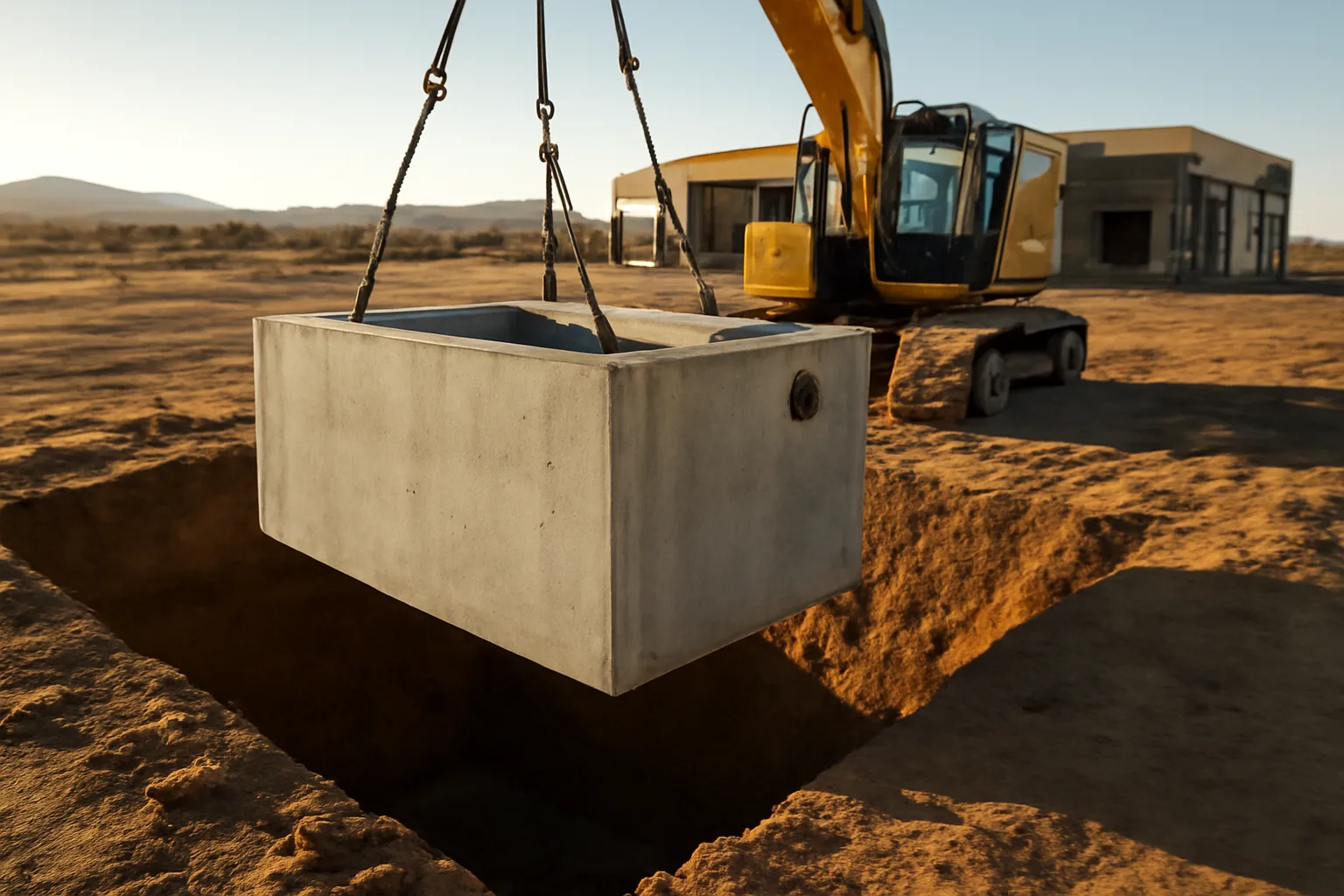
In-ground interceptors are a different world. Most POTWs require them for full-service restaurants. A precast concrete or fiberglass in-ground interceptor sized at 1,000 to 2,000 gallons (a common range for a 50 to 100 seat restaurant) costs $3,000 to $8,000 for the unit alone [7]. Installation, excavation, and plumbing connection in an Arizona metro area typically adds $4,000 to $12,000, with the high end in Scottsdale or Paradise Valley where labor rates and permitting fees trend up.
Local POTW permit fees are set municipally and vary. Confirm the current fee with your local pretreatment coordinator, because these change with budget cycles. Phoenix's fees for grease control permits have historically landed in the low hundreds of dollars, but confirm with Phoenix Water Services before budgeting [3].
Ongoing pumping in the Phoenix metro generally runs $150 to $400 per service visit for a standard in-ground interceptor, based on industry service data [7]. Cleaning frequency depends on interceptor size and your FOG load, but most municipal ordinances require cleaning when the trap reaches 25% grease accumulation by depth, which often works out to every 30 to 90 days for a busy kitchen.
Paperwork has a cost too, even when it looks free. Tracking service records, hauler permit numbers, and disposal site confirmations takes real time, and gaps in that paper trail are what inspectors cite most often.
How long does getting a grease trap permit take in Arizona?
Timeline depends almost entirely on which municipality you are in, and whether your application is complete on first submission.
For a straightforward food-service pretreatment permit in Phoenix, expect 3 to 8 weeks in the real world once back-and-forth requests for more information get factored in [3]. Tucson's Environmental Services runs on a similar rough timeline. Smaller municipalities and water improvement districts can be faster (sometimes 2 to 3 weeks) but may also have less staffing, so a complex project can drag.
The Arizona ROC plumbing license for your contractor is a separate track. A licensed ROC contractor should already hold their license. You are checking that it is active, not waiting for them to get one. You can verify any contractor's license status in real time on the ROC's public database [5].
Hauler ADEQ licensing is the longest timeline in the system. A new solid waste facility or transporter license from ADEQ can take 90 to 180 days for an initial application, depending on application completeness and ADEQ staff workload [4]. If you are starting a hauling operation in Arizona, put that timeline in your business plan from day one.
For restaurant operators, the practical sequence is: design and size your interceptor, pull your building or plumbing permit from the city, apply for the POTW pretreatment permit at the same time, finish installation, pass inspection, then start operating. Trying to open before the pretreatment permit is approved is the mistake that leads to notices of violation.
What does the Arizona grease trap manifest system look like?
The manifest, or waste hauler record, is the paper trail that proves your grease trap waste went from your interceptor to a legal disposal site. Arizona's system works through ADEQ's solid waste transporter requirements, but the form you sign at each pump-out is more often a hauler-generated service manifest than a state-printed form.
Every service visit should generate a document with the date of service, your facility address, the name and ADEQ permit number of the hauling company, the volume of waste removed (in gallons), and the name and permit number of the disposal or treatment facility receiving the waste. Keep these records for at least three years, because that is the standard enforcement lookback period at both the ADEQ and local POTW level.
Some municipalities go further. Certain Phoenix-area cities require operators to submit their grease trap service logs directly to the pretreatment program on a quarterly or annual basis. Others rely on hauler self-reporting. Confirm exactly what your local pretreatment coordinator expects in terms of submission frequency.
A few things I would do in the field. Always get a copy of the manifest before the hauler's truck leaves your property. Haulers lose paperwork. Your copy is your defense. And if your hauler cannot or will not give an ADEQ permit number when you ask, treat that as a red flag.
For how manifest requirements compare across state lines, the Alabama grease trap board and Florida grease trap board articles cover states with more centralized manifest systems.
What size grease interceptor does Arizona require?
Sizing is not set at the state level. ADEQ does not publish a universal sizing table. Your local POTW or municipality sets the minimum size, and they typically reference one of two standards: the Plumbing and Drainage Institute (PDI) method for under-sink grease traps, or the Uniform Plumbing Code (UPC) sizing methodology for in-ground interceptors [8].
Arizona has adopted the Uniform Plumbing Code. Under the UPC, interceptor capacity is calculated from the number of fixture units connecting to the interceptor, the flow rate through those fixtures, and a retention time factor [8]. A typical full-service restaurant with a three-compartment sink, prep sinks, and a dishwasher often lands in the 1,000 to 1,500 gallon range for an in-ground interceptor.
Many local programs go beyond the UPC minimum. Phoenix's FOG control program has historically required interceptors sized at no less than a 30-minute retention time at peak flow [3]. Confirm the exact local sizing standard with your pretreatment coordinator before you order equipment. Ordering an undersized interceptor and then replacing it is an expensive mistake.
Automatic grease removal devices (AGRDs) are allowed in some Arizona jurisdictions as an alternative to passive in-ground interceptors, but approval is jurisdiction-specific and almost always requires written permission from the local POTW before installation.
How do Arizona's major cities differ in their grease trap rules?
The variation is real and significant. Here is a comparison of what published sources show for four major Arizona municipalities. Confirm current requirements directly with each agency before relying on these figures.
| City / Utility | Permit Required | Published Cleaning Standard | Manifest Submission Required | Source to Confirm |
|---|---|---|---|---|
| Phoenix | Yes (Wastewater pretreatment permit) | When grease layer exceeds 25% of interceptor depth | Check with Phoenix Water Services | Phoenix Water Services Pretreatment [3] |
| Tucson | Yes (FOG Control Program permit) | Minimum every 90 days or when 25% full, whichever is sooner | Annual log submission reported | Tucson Environmental Services |
| Mesa | Yes (Industrial Pretreatment permit) | Per local ordinance; confirm with Mesa Utilities | Confirm with Mesa Utilities | Mesa Utilities |
| Scottsdale | Yes (Pretreatment permit) | Confirm with Scottsdale Water | Confirm with Scottsdale Water | Scottsdale Water |
The 25% grease depth threshold is a commonly adopted standard in Arizona's largest cities, consistent with EPA's FOG guidance [6]. But commonly adopted is not universal. A city like Casa Grande or Flagstaff may set a different threshold, and small water improvement districts in rural Arizona may have minimal written FOG rules at all. That does not make you exempt from federal pretreatment standards. It means there is less local enforcement infrastructure to catch violations early.
What happens if you operate without a grease trap permit in Arizona?
The consequences are layered and expensive.
At the local POTW level, running a food-service establishment without a required grease interceptor or without a valid pretreatment permit can produce a Notice of Violation (NOV), a compliance schedule order, fines, and in serious cases a disconnection order from the sewer system. Phoenix can issue civil penalties under its wastewater regulations [3].
At the state level, ADEQ can pursue enforcement under A.R.S. §49-262, which authorizes civil penalties of up to $25,000 per day per violation for water quality violations [2]. That top figure is for serious, knowing violations, but even smaller penalties in the $500 to $5,000 range add up fast.
At the federal level, EPA has enforcement authority over significant violations of local pretreatment programs. Most restaurants never see EPA enforcement directly. The agency typically works through the state and local programs. But if a pattern of noncompliance becomes a documented problem, federal involvement is possible.
Beyond fines, the operational risk is sewer line blockages. Grease builds up in the lateral lines connecting your facility to the main sewer when interceptors are absent, undersized, or not maintained. When that lateral backs up into your kitchen, the health department inspection that follows tends to generate more compliance headaches on top of the ones you already have.
How do you actually apply for a grease trap permit in Arizona?
The application runs through your local POTW pretreatment program, not through ADEQ. Here is the general sequence, though exact steps vary by city.
Step one: contact your local pretreatment coordinator before you do anything else. Every POTW with an approved pretreatment program has one. Phoenix Water Services, Tucson Environmental Services, and Mesa Utilities all publish pretreatment contacts. Tell them your planned operation type, your address, and your expected flow volumes. They will tell you whether you need a formal permit or just a registration, and which application packet to complete.
Step two: size your interceptor to their local standard and submit drawings. Most programs want a site plan showing the interceptor location, the pipe connection points, and the fixture schedule. Your licensed ROC plumber or mechanical engineer usually prepares this.
Step three: submit the application with the required fee. Confirm current fees with the agency. They are not stable year over year.
Step four: pull your building or plumbing permit from the city's development services or building department. This is a separate permit from the pretreatment permit, though some cities coordinate their review.
Step five: finish installation, request inspection, and get final approval before you connect to the sewer and start operating.
For operators who want a head start on the paper side, GreaseTrapPath's Interceptor + Manifest Kit at /start gives you the document templates and permit checklist before you walk into your first pretreatment meeting, so you are not starting from blank paper.
For state comparison, see how Illinois runs a similar multi-agency pretreatment framework.
What records do Arizona grease trap operators need to keep?
Recordkeeping is where most small operators get caught. Not because they failed to clean the trap, but because they cannot prove they did.
Keep a log of every pump-out with date, volume removed, and hauler name and ADEQ permit number. Keep copies of every service manifest signed by the hauler. Keep your interceptor permit or registration number and any renewal correspondence. Keep documentation of any repairs or modifications to the interceptor.
Three years is the standard enforcement lookback most ADEQ and local pretreatment programs apply, so keep records at least that long. Some programs recommend five years.
Some Phoenix-area pretreatment programs have moved toward electronic submission of service logs through an online portal. Others still accept paper logs kept on-site for inspector review. Confirm your local program's submission requirements when you receive your permit.
One thing that catches operators off guard: if you change haulers, get the new hauler's ADEQ permit number before their first service visit. The gap between haulers is when record chains break. A service manifest signed by an unlicensed hauler is not a defense in an enforcement proceeding. It is evidence of a second problem.
For how recordkeeping compares in a neighboring state with a different agency structure, the grease trap board in Colorado article covers CDPHE's approach to FOG manifests.
Frequently asked questions
Do you need a license for grease trap work in Arizona?
Yes, in multiple ways. Food-service operators need a pretreatment permit from their local POTW before connecting an interceptor to the public sewer. Grease haulers need an ADEQ solid waste transporter license. Plumbing contractors installing the interceptor need an active Arizona Registrar of Contractors (ROC) license. There is no single 'grease trap license.' The requirement depends on your role in the system.
How much does a grease trap cost in Arizona?
Small under-sink units run $200 to $600 for equipment plus $300 to $800 for licensed installation. In-ground interceptors for restaurants typically cost $3,000 to $8,000 for the unit and $4,000 to $12,000 for installation depending on site conditions and location. Ongoing pump-out service in the Phoenix metro runs roughly $150 to $400 per visit. Local POTW permit fees vary by city; confirm current fees with your pretreatment program.
How long does getting a grease trap permit take in Arizona?
For a local POTW pretreatment permit, expect 3 to 8 weeks once you submit a complete application. Incomplete submissions add time. New ADEQ hauler licenses take considerably longer, often 90 to 180 days. No approval timeline is guaranteed, so start the permit process well before your planned opening date.
Which agency issues grease trap permits in Arizona?
Local POTWs (city or utility pretreatment programs) issue permits for food-service establishments. ADEQ issues licenses for grease waste haulers and disposal sites. The Arizona Registrar of Contractors licenses the plumbers who install interceptors. No single state board owns the entire grease trap topic; authority is divided among these three layers.
What is the minimum grease interceptor size required in Arizona?
Arizona follows the Uniform Plumbing Code for sizing, but local POTWs set the minimum size for their jurisdiction. Most full-service restaurants end up in the 1,000 to 1,500 gallon in-ground range after UPC calculations. Some cities, including Phoenix, layer additional retention-time minimums on top of the UPC baseline. Confirm sizing requirements with your local pretreatment coordinator before ordering equipment.
How often do you have to pump a grease trap in Arizona?
Most major Arizona municipalities, including Phoenix and Tucson, require pumping when the grease layer reaches 25% of interceptor depth. In practice for a busy kitchen, that often means every 30 to 90 days. Some programs set an absolute minimum frequency regardless of depth. Check your specific POTW's ordinance, because the number varies by city and can be a permit condition.
Does ADEQ directly regulate restaurant grease traps in Arizona?
Not directly for most restaurants. ADEQ sets state water quality standards and licenses haulers, but it delegates day-to-day food-service pretreatment oversight to approved local POTW programs. Restaurants interact mainly with their city or utility district pretreatment coordinator. ADEQ can step in for significant violations or when a local program is not enforcing federal pretreatment standards.
Do grease trap haulers need a state license in Arizona?
Yes. Haulers transporting grease trap waste in Arizona need an ADEQ solid waste facility or transporter license under A.R.S. §49-741. You can ask any hauler for their ADEQ permit number and should keep a copy on file. Using an unlicensed hauler can expose the food-service operator to shared compliance liability if the waste is improperly disposed.
What records do I need to keep for my grease trap in Arizona?
Keep a service log for every pump-out showing the date, volume removed, and hauler name and ADEQ permit number. Keep copies of every signed service manifest. Store your pretreatment permit and any renewal documents. Maintain records for at least three years, the standard enforcement lookback period for ADEQ and most local pretreatment programs. Some programs require log submission to the city; confirm your local requirement.
Can I install a grease trap myself in Arizona?
You cannot legally install a grease interceptor connected to the public sewer in Arizona without using an ROC-licensed plumbing contractor. A self-installed interceptor will fail a city inspection, can void your pretreatment permit application, and creates liability if the installation causes a sewer backup or violation. The ROC license lookup is free and instant at the Registrar's website.
What happens if I get caught without a grease trap permit in Arizona?
Local POTW enforcement starts with Notices of Violation and civil fines. Phoenix and other cities can compel compliance through sewer disconnection orders. ADEQ can pursue civil penalties up to $25,000 per day per violation for water quality violations under A.R.S. §49-262. The practical risk also includes sewer line backups into your kitchen, which trigger health department inspections on top of environmental enforcement.
Does Arizona have a FOG (fats, oils, and grease) control program?
Yes, Arizona's major cities run FOG control programs as part of their local pretreatment programs, consistent with EPA guidance encouraging POTWs to adopt mandatory FOG programs. Phoenix, Tucson, Mesa, and Scottsdale all have FOG-specific requirements for food-service establishments. ADEQ supports these programs at the state level but does not run a separate statewide FOG program.
How is Arizona's grease trap oversight different from neighboring states?
Arizona's system is heavily municipality-driven, similar to Colorado, which delegates most pretreatment authority to local utilities. California runs a more prescriptive statewide program through the State Water Resources Control Board. Nevada and New Mexico have similarly decentralized models. The common thread across all of them is that the hauler must be state-licensed, even when the operator's permit is locally issued.
Where do I find my local Arizona pretreatment coordinator?
Start with your city's water or utilities department website and search for 'pretreatment' or 'industrial pretreatment program.' Phoenix Water Services, Tucson Environmental Services, and Mesa Utilities all publish pretreatment program contacts online. If your facility is in an unincorporated area served by a water improvement district, contact that district directly. ADEQ's website lists approved local pretreatment programs and contact information.
Sources
- U.S. EPA, National Pretreatment Program Overview (40 CFR Part 403): EPA's pretreatment regulations require local POTWs to develop and enforce pretreatment requirements for significant industrial users, including food-service establishments generating significant FOG loads.
- Arizona Legislature, A.R.S. §49-241 through §49-262 (Water Quality statutes): ADEQ water quality authority and civil penalty provisions up to $25,000 per day per violation for water quality violations in Arizona.
- City of Phoenix Water Services: Phoenix requires food-service establishments to obtain a pretreatment permit and comply with FOG control requirements including a 25% grease depth cleaning standard.
- Arizona Department of Environmental Quality, Solid Waste Program (A.R.S. §49-741): Grease waste haulers in Arizona must hold an ADEQ solid waste facility or transporter license; grease trap waste classified as special waste is subject to ADEQ manifest and recordkeeping requirements under A.A.C. R18-13-301.
- Arizona Registrar of Contractors, License Lookup and Plumbing (A-17) Classification: Plumbing contractors installing grease interceptors in Arizona must hold an active ROC license; A-17 is the plumbing contractor classification.
- U.S. EPA, National Pretreatment Program (FOG control guidance): EPA guidance recommends mandatory grease interceptors for food-service establishments and cleaning when grease accumulation reaches 25% of interceptor depth as a widely adopted standard.
- Angi (formerly Angie's List), Grease Trap Installation Cost Guide (2024 national and regional data): Under-sink grease trap units cost $200-$600; in-ground interceptors for restaurants cost $3,000-$8,000 for equipment; pump-out service in metro areas typically runs $150-$400 per visit.
- International Association of Plumbing and Mechanical Officials (IAPMO), Uniform Plumbing Code 2021: Arizona has adopted the Uniform Plumbing Code; the UPC governs grease interceptor sizing methodology based on fixture units, flow rate, and retention time.
- Arizona Department of Environmental Quality, Water Quality Division, Approved Pretreatment Programs: ADEQ maintains a list of Arizona municipalities with approved local pretreatment programs and delegates day-to-day food-service pretreatment oversight to those programs.