Last updated 2026-08-18
TL;DR
In Alabama, a grease trap costs $250 to $600 for a small under-sink unit and $1,500 to $10,000 or more for a large outdoor interceptor, before installation. Add $500 to $2,500 for a licensed plumber to set it. You also need a plumbing permit from your local building department. FOG hauling runs $75 to $350 per pump-out, depending on county.
How much does a grease trap cost in Alabama?
A grease trap in Alabama costs $250 to $600 for a small under-sink unit and $1,500 to $3,500 for a 1,000-gallon outdoor tank, before you pay a plumber to install it. The equipment price splits into two different worlds: passive indoor units and outdoor interceptors.
A passive grease trap is the small under-sink type rated for 20 to 50 gallons per minute (GPM). The unit runs $250 to $600. Brands like Watts and Thermaco Trapzilla dominate that end of the market. A licensed plumber's installation adds another $400 to $900 depending on whether they're retrofitting old pipe or working with a fresh rough-in. Total landed cost for a small café or food truck commissary: $650 to $1,500, all in [1].
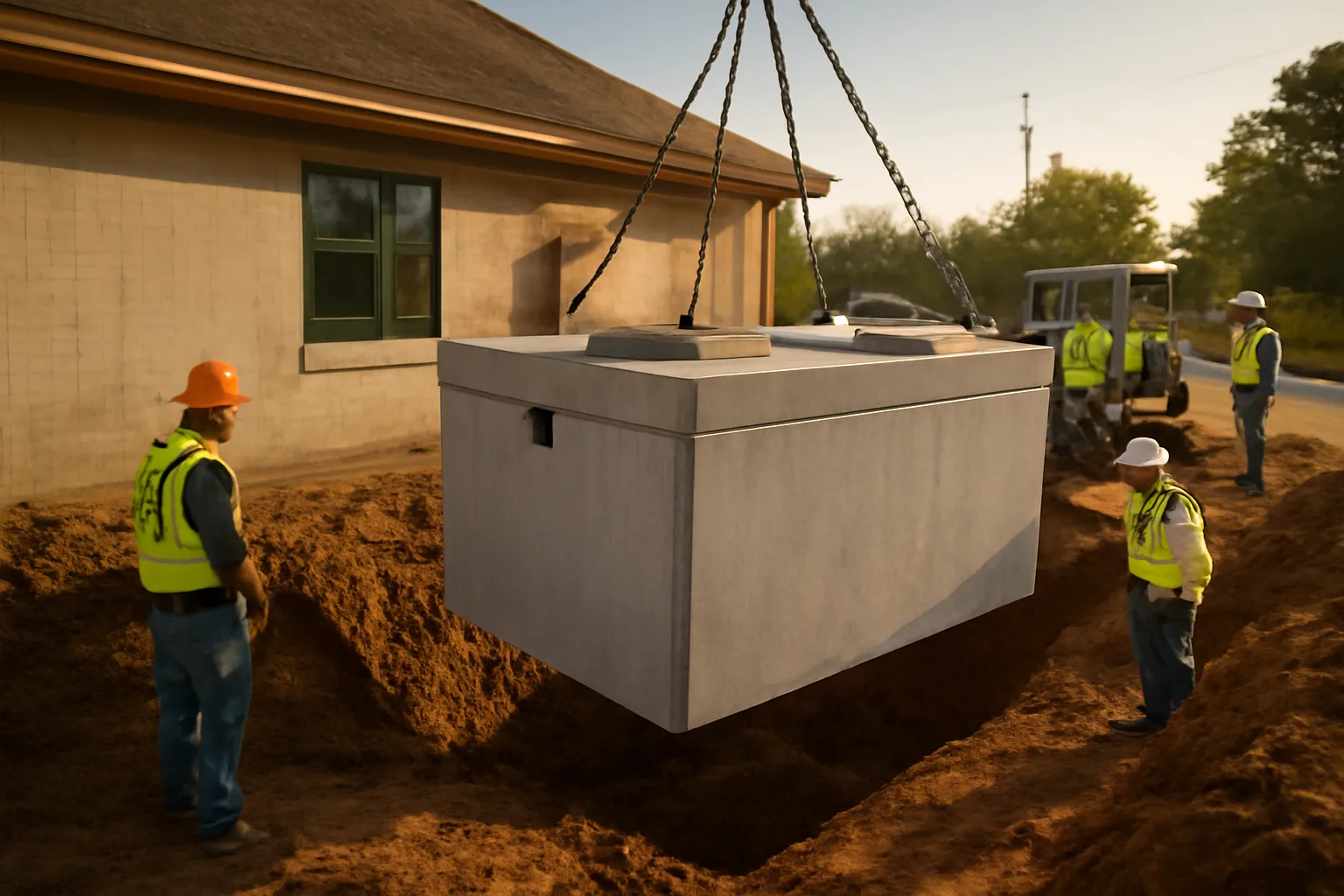
Outdoor concrete interceptors are a different animal. A 1,000-gallon precast concrete unit, which is what most full-service restaurants end up needing, runs $1,500 to $3,500 for the tank. Excavation, backfill, and installation by a plumbing contractor in Alabama typically adds $2,000 to $5,000 depending on soil conditions, access, and local permit fees. High-density polyethylene (HDPE) tanks sometimes cost less on the unit price but require careful bedding, and not every local inspector approves them, so confirm with your municipality before you order [2].
Budget $3,000 to $8,500 for a typical full-service restaurant interceptor install in Alabama. Larger operations, like hotels or institutional kitchens, can push $15,000 to $25,000 once you factor in the 1,500- to 2,500-gallon tanks some POTWs (publicly owned treatment works) require.
Nobody has clean statewide average data specific to Alabama. The closest benchmark is the EPA's FOG guidance, which puts median interceptor installation costs nationally at roughly $4,000 to $6,000 for food service establishments, and that figure has inflated since it was published [3].
What are the ongoing grease trap costs in Alabama?
The recurring cost is where owners get surprised. Pump-out service in Alabama runs $75 to $180 for a small under-sink trap and $150 to $350 for a 1,000-gallon outdoor interceptor per visit, and a restaurant pumping monthly can pay $1,800 to $4,200 a year just for hauling.
The equipment purchase is a one-time hit. Everything after that repeats.
Pump-out service (sometimes called grease trap cleaning or grease hauling) is required at a minimum frequency set by your local authority. Alabama's Department of Environmental Management (ADEM) defers FOG program specifics to local municipalities and POTWs, so frequency requirements vary by county [4]. Jefferson County has its own FOG control program, and Birmingham's sewer authority enforces pump-out schedules separately from ADEM's general pretreatment rules.
Pump-out pricing is based on hauler quotes in the Birmingham, Huntsville, and Mobile markets. Rural areas sometimes cost more because haulers factor in drive time.
A restaurant required to pump monthly pays $1,800 to $4,200 per year for hauling alone. That's real money and it belongs in your pro forma from day one.
Manifest and waste tracking documentation is another cost people forget. Many Alabama municipalities require the restaurant to keep a signed waste manifest from the licensed hauler for each pump-out, usually for three years. If your hauler doesn't provide one, you pay the fine, not them. Some operators buy pre-formatted manifest books. Others use a spreadsheet. Either way, you need a documented chain of custody for every load.
Do you need a license for a grease trap in Alabama?
No, there's no license for a grease trap itself. You need a plumbing permit to install one, the installer must hold an Alabama plumbing license, and your ADPH food service permit assumes adequate grease control is already in place.
Here's how it works. The grease trap is part of a commercial plumbing system, and that system requires a permit from your local authority having jurisdiction (AHJ), usually your city or county building department [2].
The person physically installing the trap must hold a valid Alabama plumbing license. Alabama issues plumbing licenses through the Alabama Plumbers and Gas Fitters Examining Board. A journeyman plumber can do the work under a licensed master, and the master is the permit holder [5].
On the business side, food service establishments in Alabama must hold a food service permit from the Alabama Department of Public Health (ADPH). Inspectors check that you have an adequate grease control device as part of plan review before you open. The rules are in the Alabama Rules for Food Establishment Sanitation, Chapter 420-3-22 [6]. If ADPH inspects and finds your kitchen produces grease-laden waste but you have no interceptor, they can hold your permit.
If your facility discharges to a municipal sewer, your local POTW may require a separate industrial pretreatment permit or at least a FOG control agreement. This is separate from the ADPH food permit. Contact your local sewer authority directly, because requirements differ between, say, Montgomery Water Works and Baldwin County's system.
Short version: no single "grease trap license," but you need a plumbing permit for installation, an ADPH food service permit that presupposes grease control, and maybe a pretreatment agreement with your local sewer utility.
How long does a grease trap installation take in Alabama?
A small under-sink passive unit takes one to two days from permit issuance to passing inspection. An outdoor interceptor takes four to six weeks from permit application to final inspection, assuming no soil surprises or scheduling delays.
The small unit ships quickly, and installation is a few hours of plumber time. Easy.
Outdoor interceptors are slower on every front. Permit review alone can take five to fifteen business days at most Alabama building departments, though larger cities like Huntsville run faster digital reviews. After permit approval, you still schedule excavation, tank delivery, installation, inspection, and backfill. Four to six weeks is a realistic window for a ground-level interceptor job.
Timing matters if you're in a buildout. Grease interceptors are almost always on the critical path. A contractor who hasn't ordered the tank before permit approval adds two to three weeks of wait time, because precast concrete tanks aren't stocked at every supplier in Alabama. Confirm lead times with your supplier and your plumbing contractor before you sign your lease.
Permit processing time varies widely by AHJ. Some rural counties still use paper submittals that add a week or more. Confirm the current timeline with the specific building department where your project sits.
What size grease trap do you need in Alabama?
A small sandwich shop with a single three-compartment sink usually needs a 20 to 35 GPM passive trap. A full-service restaurant with a dishwasher, prep sinks, and a fryer almost always needs an outdoor interceptor, typically 500 to 1,500 gallons. Sizing follows the plumbing code your AHJ has adopted.
Alabama generally follows the International Plumbing Code (IPC) or the Uniform Plumbing Code (UPC) depending on the municipality, with local amendments. IPC Chapter 10 covers grease interceptors and gives the formula: trap size is calculated from the drainage fixture units (DFUs) of your kitchen equipment, the flow rate, and the required retention time [7].
High-volume operations sometimes need 2,000+ gallon tanks.
Your engineer or plumbing contractor should size the trap from actual fixture counts and flow rates, not a guess. Undersizing is expensive: you pump out more often, you fail inspections, and you eventually upsize the tank anyway.
The table below summarizes typical size ranges by establishment type.
| Establishment type | Typical trap size | Approximate unit cost |
|---|---|---|
| Small café / food truck commissary | 20 to 35 GPM passive | $250 to $600 |
| Fast food / quick service | 500 to 750 gal interceptor | $1,200 to $2,500 |
| Full-service restaurant | 1,000 to 1,500 gal interceptor | $1,800 to $3,800 |
| Hotel / institutional kitchen | 1,500 to 2,500 gal interceptor | $3,000 to $7,000 |
Unit costs are equipment only, before installation. Confirm sizing with your licensed plumbing contractor and the AHJ plan reviewer [1][7].
What permits and inspections are required in Alabama?
You need a plumbing permit from your local building department before installation, a rough-in inspection before the tank is backfilled, a final plumbing inspection after hookup, and an ADPH pre-opening inspection that verifies your grease control device is in place. Permit fees run roughly $50 to $300.
Here's the path for most Alabama jurisdictions.
First, you or your contractor submits a plumbing permit application to the local building department. The application needs a site plan showing where the interceptor will sit, a plumbing diagram showing how kitchen fixtures connect to the trap and then to the sewer, and the trap specifications (manufacturer, model, rated capacity). Some AHJs also want an engineer's stamp on commercial projects.
After permit issuance, work begins. The building department schedules a rough-in inspection before the tank is backfilled or the under-sink trap is enclosed. Pass that and you keep going. Once everything is hooked up, you get a final plumbing inspection. Some jurisdictions also run a separate sanitation or FOG inspection through the sewer authority.
ADPH runs its own pre-opening food service inspection, and the inspector verifies that your grease control device is in place and working. The Alabama Rules for Food Establishment Sanitation, Chapter 420-3-22, require that equipment and physical facilities be kept in good repair and clean [6]. That language is the hook ADPH uses to cite operators who let traps go unmaintained.
Fees vary. A typical plumbing permit in Alabama costs $50 to $300 depending on the jurisdiction and project valuation. Some counties charge a flat fee, others a percentage of construction value. Confirm current fees with your specific building department.
How do grease trap costs in Alabama compare to nearby states?
Alabama sits in the middle of the Southeast cost range. Licensed plumber labor here is generally lower than in Georgia and Florida but comparable to Arkansas and Mississippi.
If you're benchmarking before a buildout, grease trap cost in Georgia and grease trap cost in Florida are worth reading because those states have more mature, more documented FOG programs that show how permit and inspection costs stack up against Alabama's lighter statewide mandate. Grease trap cost in Arkansas is the closest peer comparison given similar labor markets.
One real difference stands out. Some Florida municipalities require quarterly third-party inspections with written reports submitted to the sewer authority, which adds $200 to $400 per year in compliance costs that Alabama generally doesn't impose at the state level. Alabama's decentralized approach means lower statewide compliance overhead, but it also means less consistency, so one county may be much stricter than the one next door.
What do FOG hauling manifests and record-keeping cost in Alabama?
The paperwork itself is nearly free, but the fine for missing it is not. Alabama requires licensed septage haulers to keep records of waste transported and disposal sites used, and most municipalities require you to retain the manifest from each pump-out for about three years.
This is the part nobody talks about until they get cited.
FOG stands for fats, oils, and grease. When a licensed hauler pumps your interceptor, they're transporting a nonhazardous but regulated waste. Alabama requires licensed haulers to maintain transport and disposal records under ADEM's wastewater and pretreatment rules [4].
For restaurant operators, the obligation is simpler: keep the manifest your hauler gives you for each pump-out. Most haulers provide a two-part ticket. You keep one copy. That copy shows the date, volume pumped, hauler license number, and disposal facility. If ADPH or your local POTW asks for records, that paper is your defense.
If you're setting up your record system from scratch, GreaseTrapPath's Interceptor + Manifest Kit ($199 one-time) gives you pre-formatted manifest templates and a compliance log built for Alabama's documentation expectations. It's a reasonable shortcut if you want a ready-made paper trail, but a binder full of your hauler's tickets works too. The record matters more than the format.
Some POTWs in Alabama are moving toward electronic reporting portals. Check with your local sewer authority for a preferred submission format before you build a paper-only system.
What are the biggest cost mistakes Alabama operators make?
The most expensive mistake is undersizing the trap. Over three years, a trap that's one size too small costs more in extra pump-outs than the price gap between the correct unit and the small one. And it's common.
Here's how it happens. A contractor quotes a smaller unit to win the bid, the inspector passes it on opening day, and then the operator is pumping twice a month instead of twice a year because the trap saturates fast.
Skipping the permit is the second mistake. Some operators in rural Alabama try to install without pulling a plumbing permit. If a health inspector finds an unpermitted interceptor, the fine plus the cost of retroactive permitting and inspection almost always exceeds what the permit would have cost. And in the event of a backup into the sewer main, an unpermitted installation gives the municipality grounds to charge you for remediation.
Choosing a hauler who doesn't provide manifests is the third mistake. If your hauler dumps FOG illegally in a storm drain or an unlicensed site, you can be held partly liable if you can't show you vetted them. Verify your hauler's ADEM license before you sign a service agreement [4].
Delaying the interceptor order during buildout adds real calendar time. Order the tank the same week you pull the permit, not after approval. Lead times on precast concrete tanks in Alabama can run two to four weeks.
Where to confirm current Alabama grease trap rules and fees
The authoritative answer for your location comes from two or three places, not one. Alabama's FOG program is genuinely decentralized, so you confirm food rules with ADPH, plumbing permits with your local building department, and sewer discharge rules with your local POTW.
For food service permitting and sanitation rules, the Alabama Department of Public Health (ADPH) is your starting point [6]. Their plan review process flags grease control requirements before you open.
For plumbing permits and code interpretation, your local building department is the authority. If you're in an unincorporated county area, the county engineering or building office handles permits.
For sewer discharge and pretreatment requirements, contact your local POTW or municipal sewer authority directly. ADEM's pretreatment rules are codified in the Alabama Administrative Code Chapter 335-6-5, which covers local pretreatment programs [4].
For hauler verification, ADEM's water program can confirm whether a hauler holds a valid septage or grease waste hauler permit. Ask for the hauler's ADEM permit number and verify it before you sign a service contract.
If you want to see how neighboring states handle costs and documentation differently, grease trap cost in California and grease trap cost in Illinois both have more codified statewide FOG programs that show what a heavier regulatory framework looks like in practice. The GreaseTrapPath manifest kit also comes with a state-specific compliance checklist you can cross-reference once you've confirmed your local rules.
Frequently asked questions
Do you need a license to own or operate a grease trap in Alabama?
No separate license exists just for owning a grease trap. You need a plumbing permit from your local building department to install one, and the installer must hold a valid Alabama plumbing license. On the business side, your food service permit from ADPH presupposes that adequate grease control is in place. Contact your local building department and ADPH for current requirements.
How much does a grease trap cost in Alabama total, installed?
A small under-sink passive trap runs $650 to $1,500 installed. A 1,000-gallon outdoor interceptor for a full-service restaurant typically costs $3,000 to $8,500 all in, including excavation and the plumber's labor. Larger tanks for high-volume kitchens can push $15,000 to $25,000. Confirm quotes with at least two licensed plumbing contractors in your market before budgeting.
How long does it take to get a grease trap installed in Alabama?
A small under-sink unit can be installed within one to two days of permit issuance. An outdoor interceptor typically takes four to six weeks from permit application to final inspection, accounting for permit review (five to fifteen business days at most Alabama building departments), tank delivery lead times, excavation, and inspection scheduling. Order the tank the same week you apply for the permit.
How often does a grease trap need to be pumped in Alabama?
Pump-out frequency is set by your local municipality or POTW, not ADEM statewide. Most Alabama food service operators are on monthly to quarterly schedules depending on kitchen volume and trap size. Many Alabama haulers use the 25 percent rule: pump when the combined FOG and solids layer reaches 25 percent of the trap's liquid depth. Confirm your local requirement before setting a schedule.
What does grease trap pumping cost in Alabama?
Pump-out pricing in Alabama runs approximately $75 to $180 for a small under-sink trap and $150 to $350 for a 1,000-gallon outdoor interceptor per visit, based on market rates in Birmingham, Huntsville, and Mobile. Rural areas may cost more due to hauler travel. An annual pumping bill for a restaurant on a monthly schedule runs $1,800 to $4,200.
Does Alabama have a statewide FOG (fats, oils, and grease) program?
No single statewide FOG program exists. ADEM sets pretreatment rules under Alabama Administrative Code Chapter 335-6-5, but FOG control programs are administered locally by each municipality or POTW. That means requirements for trap sizing, pump-out frequency, and reporting vary significantly between Jefferson County, Mobile, Huntsville, and rural areas. Always confirm requirements with your specific local sewer authority.
Can I install a grease trap myself in Alabama without a plumber?
No. Commercial plumbing work in Alabama requires a licensed plumber, and a plumbing permit must be pulled before installation. Operating without a permit risks fines and retroactive inspection costs that routinely exceed the original permit fee. For any food service establishment subject to ADPH oversight, a properly permitted and inspected installation is also required to keep your food service permit.
What records do Alabama grease trap operators have to keep?
Most Alabama municipalities and POTWs require operators to retain pump-out manifests from licensed haulers, typically for two to three years. Each manifest should show the date, volume removed, hauler's license number, and disposal facility. Some local sewer authorities also require periodic inspection reports. Check with your specific POTW for their format and retention requirements.
Are grease trap costs tax-deductible for an Alabama restaurant?
Generally yes, as a business equipment expense. A grease interceptor is depreciable property under IRS rules, and installation costs are typically capitalized with the asset. Routine pump-out and maintenance costs are ordinary and necessary business expenses. Confirm treatment with a CPA familiar with Alabama business tax rules, since depreciation schedules and local tax rules vary.
What happens if my grease trap fails an Alabama inspection?
A failed inspection typically results in a correction order with a deadline to re-inspect. If the failure involves an illegal discharge to the sewer system, your local POTW can issue a notice of violation and fine. ADPH can place conditions on your food service permit. Repeated violations can result in permit suspension. Fixing deficiencies quickly and documenting corrective actions is your best protection.
How does the grease trap permit process work in Alabama?
Submit a plumbing permit application to your local building department with site and plumbing plans showing the trap location, connections, and specifications. After permit issuance, schedule a rough-in inspection before enclosing any work, then a final inspection after hookup. ADPH also reviews grease control as part of their food service pre-opening inspection. Permit fees run roughly $50 to $300 depending on the jurisdiction.
What is the difference between a grease trap and a grease interceptor in Alabama?
The terms are often used interchangeably, but technically a grease trap is a small passive device installed under a sink, rated in GPM, while a grease interceptor is a large outdoor tank, rated in gallons. Alabama building departments and plumbing codes use both terms. IPC Chapter 10 distinguishes them by flow rate and location. Your AHJ and your plumber will know which type your kitchen requires.
Sources
- EPA, Controlling Fats, Oils, and Grease Discharges from Food Service Establishments (EPA 833-R-04-012): Median interceptor installation costs nationally at $4,000 to $6,000 for food service establishments; unit cost ranges for passive and outdoor interceptors.
- International Code Council, International Plumbing Code Chapter 10 (Traps, Interceptors, and Separators): Commercial plumbing installation requires a permit from the local authority having jurisdiction; HDPE tank suitability subject to local approval.
- EPA, Fats, Oils, and Grease (FOG) Control in Sanitary Sewer Systems (EPA/600/R-04/168): National median interceptor installation cost benchmark used as closest available data given absence of Alabama-specific statewide average.
- Alabama Department of Environmental Management, Water Division: ADEM administers pretreatment rules under Chapter 335-6-5; FOG program specifics deferred to local POTWs; licensed haulers must maintain waste transport and disposal records.
- Alabama Plumbers and Gas Fitters Examining Board: Plumbing installation in Alabama requires a valid license from the Alabama Plumbers and Gas Fitters Examining Board; master plumber is the permit holder.
- Alabama Department of Public Health, Rules for Food Establishment Sanitation, Chapter 420-3-22: ADPH requires food service establishments to maintain equipment in good repair and keep grease traps clean; plan review verifies adequate grease control device before opening.
- International Code Council, International Plumbing Code Section 1003, Interceptors and Separators: Grease interceptor sizing is based on drainage fixture units, flow rate, and retention time per IPC Chapter 10 formula.