Last updated 2026-08-21
TL;DR
A grease trap is a tank that slows kitchen wastewater so fats, oils, and grease separate before the water enters the sewer. You start by confirming local plumbing and sewer-use rules, pulling the permit, installing an accessible unit sized to that code, then pumping on a set schedule and keeping hauler manifests. Confirm forms and fees with your board. There is no single national paper path.
What is a grease trap?
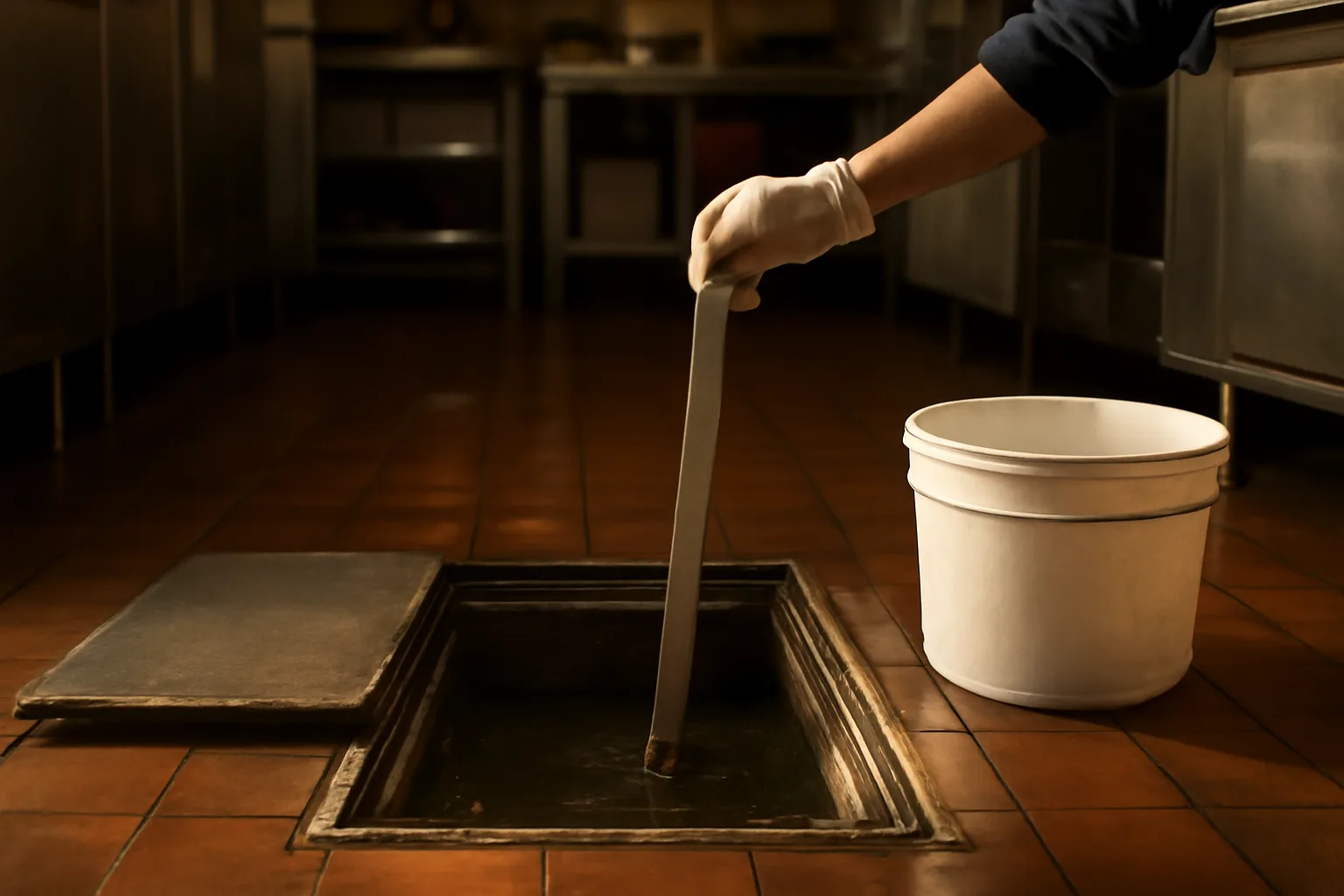
A grease trap is a plumbing interceptor that holds kitchen wastewater long enough for fats, oils, and grease to cool and float, and for heavier food solids to sink. The clearer water in the middle leaves to the building drain, then to the public sewer or a septic tank. People also call the same family of devices grease interceptors, FOG interceptors, or grease removal devices. The name on the invoice matters less than the code section your inspector cites.
FOG is the usual shorthand. It is the mix of animal fat, cooking oil, shortening, dairy, and oily sauces that leaves a prep sink, wok line, or dishwasher. In a pipe it cools, sticks, and narrows the bore. That is how a kitchen line becomes a sewer backup two blocks away.
Federal pretreatment rules do not publish a national grease trap license. They ban the discharge that causes the blockage. 40 CFR 403.5 says publicly owned treatment works may not be fed "Solid or viscous pollutants in amounts which will cause obstruction to the flow in the POTW resulting in Interference." [1] Cities then write sewer-use ordinances and plumbing amendments that name the device, the size, and the pump schedule.
If you run food service, this tank is not optional. It is how you stay inside the local pretreatment program and pass the health inspection. EPA built the National Pretreatment Program so local sewer agencies can keep oil, grease, and other interfering wastes out of collection systems and plants. [5]
A small box under a three-comp sink and a 1,500 gallon vault in the parking lot are both grease traps in ordinary speech. Codes often split them by type and rating. Read that split before you buy steel.
How do you start grease trap work without guessing?
You start by finding the two local documents that actually bind you: the plumbing code in force (often the International Plumbing Code or the Uniform Plumbing Code, as adopted) and the sewer-use or FOG ordinance from the city, county, or sanitary district. Then you pull the plumbing permit, submit a sizing sheet the authority will accept, install an accessible unit, and set a pumping contract with a licensed hauler who leaves a manifest. Confirm every form name and fee with that board. I would not order a tank first.
Call the building department and the water reclamation or pretreatment office on the same morning. Ask which code edition they inspect to, whether food service needs a separate FOG registration, and who signs off on interceptor sizing. Write down the person's name. Rules in California are not the rules in Florida.
Get a kitchen plan that shows every fixture that can discharge grease: prep sinks, floor sinks, wok ranges, and dishwashers if the local code even allows a dishwasher on that line. IPC Chapter 10 is the model many states use for interceptors and separators. [8]
Apply for the plumbing permit. Some POTWs also want an industrial user or FOG permit. The Clean Water Act pretreatment framework sits in 33 U.S.C. 1317 and in 40 CFR Part 403. Local programs implement it. [6] [9]
Install so the lids open without moving a freezer. FDA Food Code section 5-402.12 states, "If used, a grease trap shall be located to be easily accessible for cleaning." [3] Inspectors quote that line.
Hire a hauler who can legally take brown grease. Set the first pump date before opening, not after the first backup. Keep every manifest.
Skip enzyme bottles as your plan A. Plenty of sewer agencies restrict additives because they can push grease downstream instead of removing it. If a salesperson promises you can stop pumping, that is a waste of money until your ordinance says otherwise.
Who actually has to install a grease trap?
Almost every food service establishment that cooks or prep-washes into a public sewer will be told to install one. The trigger is local. The International Plumbing Code requires a grease interceptor or automatic grease removal device to take drainage from fixtures and equipment with grease-laden waste in food prep areas. [8] A coffee counter that only rinses mugs may get a waiver. A smoked-meat pit will not.
Hospitals, schools, grocery kitchens, commissaries, and ghost kitchens get pulled in the same way as storefront restaurants. The menu and the fixtures decide it, not the sign over the door.
Discharge to a septic tank instead of a POTW and you still have a grease problem. Grease kills the tank and the drainfield. Onsite rules are a different code family. Confirm with the health department that issues the septic permit, not only the city plumber.
EPA's pretreatment materials treat food service FOG as a collection-system problem that local programs have to control. [4] [5] Your town may run its own approved pretreatment program under 40 CFR 403.8, or it may sit under a state program. [9] Either way, someone owns the sewer and they care about your fryer.
I would not take a landlord's word that the building already has one. Ask for the last three pump manifests and the interceptor location. If nobody can point to a lid, you do not have a working trap.
New York City's Department of Environmental Protection runs a named FOG program for food service connections to that system, which is the kind of city overlay you should expect in large metros. [11] Texas Commission on Environmental Quality publishes FOG assistance for the same reason: local sewers clog, and the state wants food service to keep grease out. [12]
What is the difference between a grease trap and a grease interceptor?
People use the words as synonyms. Inspectors often do not. The device you install has to match the term your code uses, so learn the split before the plan review does it for you.
Hydromechanical grease interceptors (the indoor steel or poly boxes, sometimes still called grease traps) use a flow control device and internal baffles. They are rated in gallons per minute under referenced product standards such as ASME A112.14.3 and PDI-G101. Common shop ratings run 7, 10, 15, 20, 25, 35, and 50 GPM. They sit close to the fixture.
Gravity grease interceptors are large-volume tanks, often 300 to 2,000 plus gallons, usually outside and in-ground. They rely on retention time. Many ordinances want something like 24 to 30 minutes of detention at peak flow, but the exact method is local. Confirm the sizing formula with the board. Do not copy a number from a forum.
Automatic grease removal devices skim floating FOG into a container on a timer. Some jurisdictions accept them. Some do not. Get the acceptance in writing.
| Kind | Where it usually sits | Rating language | Typical buyer |
|---|---|---|---|
| Hydromechanical interceptor | Indoors, under or near the sink | GPM | Small cafe, bar, remodel |
| Gravity interceptor | Yard or parking lot | Gallons | Full restaurant, commissary |
| Automatic GRD | Indoors, near the line | GPM plus skim cycle | Sites that will actually empty the pail |
If a contractor says you need both, they may be right. A huge outdoor tank does not help a dishwasher that the code says cannot tie to it. Ask the plan reviewer, not the tank vendor.
For everyday speech in this guide, grease trap still means the whole family. Just do not put that casual wording on a permit form if your city uses interceptor as the legal term.
What paper do you need before you install anything?
The paper path is local, but the stack looks the same in most towns. Assemble it before a tank shows up on a truck.
You want a plumbing permit application, a fixture schedule, a sizing calculation the reviewer recognizes, a site plan that shows lid access and the sample port if they require one, and manufacturer cut sheets. If the city runs a FOG program you also want their registration form. Pretreatment programs under 40 CFR 403.8 are the reason that second form exists in bigger systems. [9]
Some states publish hauler licensing on top of the building permit. The person who pumps you may need a septage or special-waste credential. Ask the environmental agency, not only the plumber.
Do not invent a processing time in your head. Boards run behind. They also run fast. I have no honest national number for turnaround, and anyone who quotes one without naming your office is guessing. Confirm with the relevant board.
Plan review comments often come back on dishwasher connections, garbage disposers (many FOG ordinances ban them), and outdoor tank traffic loading. Fix those on paper. Opening with a red tag on the interceptor is a bad first week.
Keep copies of the approved drawings on site. The field inspector will ask.
If you work across states, start with the local board pages, not a national myth. Readers sizing a unit in Georgia or Arizona need that state's adoption of IPC or UPC plus the city FOG add-on.
Fees belong in the same phone call. I will not invent a current permit fee, a quota, or an approval clock. Those are board-confirmable facts. Ask, write the answer down, and file it with the drawings.
How do you size a grease trap?
You size it the way your adopted code and FOG ordinance tell you to size it. That is the only answer that survives inspection. Methods you will see: drainage fixture units, peak flow in GPM with a short drain time, seating or meals-per-peak-hour formulas, and manufacturer flow ratings for hydromechanical units.
IPC Chapter 10 points plan reviewers at interceptor requirements and leaves a lot of the numeric method to the local amendment or to referenced standards. [8]
A 20 GPM indoor unit is not the restaurant size. It is a flow rating. If your fixtures can dump faster than the flow control allows, you overflow the trap and send grease down the line anyway. I would rather oversize a little on flow than chase backups. Oversizing a 2,000 gallon vault because a salesperson gets paid on gallons is a different mistake. You then pay to pump water.
Dishwashers are the usual fight. High-temp, high-flow machines can blow out a small interceptor. Some codes keep dishwashers off the grease line. Confirm before you rough-in.
Give the reviewer the menu. A bakery is not a fried-chicken shop. If they have a published worksheet, use that worksheet. Do not send a napkin sketch.
Nobody has a single federal size chart for food service establishments. EPA tells cities to control FOG. It does not publish your tank size. [4]
If two formulas are on the table, I would run both and take the one the reviewer already uses. Winning an argument with a vendor sheet is a waste of a week.
How often do you pump a grease trap?
As often as the ordinance says, and sooner if the tank hits the solids-and-grease cap. Many local FOG programs use a 25 percent rule: pump when floating grease plus settled solids fill 25 percent of the liquid depth. That figure is common in city codes. It is not a number I will pin on a federal statute. Confirm the trigger your board wrote down.
EPA's food-service pretreatment fact sheet walks through why interceptors have to be maintained so FOG does not leave the tank and enter the collection system. [4] Maintenance is the point. The exact percent or the exact number of days is local.
Some cities also set a maximum interval, such as 90 days, even if the tank looks clean. I will not invent your interval. Read the ordinance.
Measure with a sludge judge or dipstick at the same spot each time. Log the grease layer and the solids layer. If you cannot measure, you are guessing, and guessing is how you meet a camera crew in the street.
Pump the whole tank. Skimming only the top and leaving the bottom sludge is a shortcut that fails the next inspection.
After pump-out, refill with water if the manufacturer or the ordinance says to. An empty hydromechanical unit can let the next dump shoot through.
Winter grease is thicker. After a holiday catering week, check early. A new brunch menu can fill a tank that looked fine in February.
What records and manifests do inspectors actually ask for?
Inspectors ask for pump-out manifests, the interceptor location sketch, employee training notes, and sometimes sample-port records if you are a permitted industrial user. The manifest should name the generator, the date, the gallons, the hauler, and the disposal facility. If your state runs a waste-tracking form, use that form.
Keep the paper where someone besides you can find it at 8 a.m. when you are at the bank. A binder in the office beats photos lost on a phone.
How long do you keep it? Local rule. Multi-year retention is common in pretreatment programs built on 40 CFR Part 403, but I will not swear your city uses three years. [5] [9] Confirm with the board.
If you want pre-assembled interceptor logs and manifest sheets in one pack, GreaseTrapPath sells a $199 one-time Interceptor + Manifest Kit. You can also build the same file with the hauler's tickets and a cheap notebook. The kit is optional. The file is not.
Never let a hauler leave without a copy. If they email it later and disappear, you have no proof of the pump-out.
Some states want you to use only licensed grease haulers. Ask. Paying cash to a person with a vacuum truck and no paperwork is how you inherit a dumping problem.
Cross-check gallons on the invoice against the tank volume. A 1,000 gallon tank that was pumped for 200 gallons needs an explanation. That mismatch is one of the first things a sharp inspector notices.
What kitchen habits keep you out of a blockage notice?
Train the line. Scrape plates into the trash. Dry-wipe pans before they hit the sink. Collect fryer oil in a closed rendering bin. Keep the sink screens in place. Post one sheet in the language people actually speak on your shift.
Do not pour fryer oil in the interceptor. It is not a dumpster. Rendering oil has value and it belongs in a closed container that a renderer hauls.
Garbage disposers send solids that fill a 25 percent cap faster. Many FOG ordinances ban them in commercial kitchens. Check before you install one. EPA's food-service fact sheet is about keeping FOG out of the collection system, not about grinding it finer. [4]
Wash floor mats in a mop sink that actually ties to the interceptor, not in the parking lot. Parking-lot washdown is how you make the storm drain your second sewer.
I would spend money on strainers and a rendering contract before I spent it on enzyme dosing. If your ordinance bans additives, the bottle is worse than a waste of money. It is a violation.
Got an automatic skimmer? Empty the cup on the schedule. A full cup is a clogged unit.
Retrain after every hire. One new prep cook pouring bacon grease in the three-comp sink undoes a good quarter.
What does a first year of grease trap operations look like?
Month one is proving the install matches the approved drawing. Get the inspection signed. Photograph the open tank, the flow control, and the sample tee.
Months two through four you learn the real fill rate. Measure monthly even if the ordinance says quarterly. A new menu or a brunch rush will change the curve.
By month six you should know if the unit is undersized. Recurring 25 percent hits in under 30 days mean the tank is wrong or the kitchen is dumping oil. Fix the behavior first. Then talk to the reviewer about a larger unit.
Budget pumping as a line item, not a surprise. I will not quote a national pump-out price because disposal tipping fees and truck time vary by region, and nobody publishes a clean national series I trust. Get three local quotes. Confirm any city-imposed hauler list with the board.
Tell your insurer you have an in-ground tank if you do. Traffic-rated lids matter. That is a separate conversation from the FOG permit.
Expand seats or add a fryer and you may have triggered a resize. Call before the equipment lands.
Look up the board that actually inspects you. A Colorado shop and an Alabama shop will not share forms. The physics of floating grease does not change. The worksheet does.
End the year with a folder: approved drawing, final inspection, every manifest, dipstick logs, training dates. That folder is the first-year job.
What should you confirm with your local board?
Confirm the adopted plumbing code edition, the FOG ordinance section, whether dishwashers and disposers may tie in, the official sizing method, the pump-out trigger (percent, days, or both), hauler licensing, manifest form, record retention years, and every fee. I am not going to invent a fee, a quota, or a processing time. Those change, and they are not national.
California's statewide sanitary sewer systems order (State Water Board Order WQ 2022-0103-DWQ) pushes collection systems to run FOG control programs where FOG causes spills. [7] That is why a city in California may feel stricter than a town that has not had a spill. It still does not set your tank size.
State pages help you find the board. They do not replace the city. See the local board notes for Connecticut or Hawaii if that is your map. Then call the city.
If two agencies disagree (health vs. plumbing vs. pretreatment), get the conflict in email and ask who wins in the field. Do not pick the answer you like.
Ask who can legally haul your brown grease and where it may be taken. A cheap pump-out that cannot name the disposal plant is not cheap. It is unfinished paper.
Should you install an indoor unit or an outdoor tank?
Choose indoor hydromechanical when the load is small, the slab is already poured, and the inspector accepts GPM-rated units for your menu. Choose outdoor gravity when the kitchen is a real production line and you can give the hauler truck access that does not block the fire lane.
Access is the decision most owners regret. A legal tank under a deck you cannot open is an illegal tank in practice. Food Code 5-402.12 is about cleaning access, not about hiding the box. [3]
Traffic lids cost more. They cost less than a crushed cover and a trip claim.
Cold climates: an outdoor trap can freeze at the lids if it sits too high or stays idle. Ask local installers what fails in January. I would not ship a design from a Sun Belt catalog into the mountains without that conversation.
Indoor units stink if you skip pumping. Outdoor units stink too, just farther from the pass. Neither is set and forget.
For a remodel in an old building, indoor is often the only option that does not mean cutting the parking lot. For a new build, I would put a gravity tank in the civil drawings on day one.
The physics stay the same from one state to the next. The form number does not. Use your board, not a catalog photo, to pick the legal type.
What happens if you skip grease trap compliance?
A FOG blockage can become a sanitary sewer overflow. EPA estimates that there are at least 23,000 to 75,000 sanitary sewer overflows per year, not including sewage backups into buildings. [2] EPA's 2004 Report to Congress on CSOs and SSOs reviews overflow impacts and controls in collection systems, which is the pile your grease joins if it leaves the tank. [10]
Local results look like this: a Notice of Violation, mandatory pumping, a camera inspection bill, civil penalties under the sewer-use ordinance, and in ugly cases a shutdown until the interceptor is brought into spec. If the overflow hits a waterway, the Clean Water Act stack gets involved through the POTW and the state. [6]
I would treat one backup as a full system review, not a janitorial event. Find the layer thickness, the last manifest, and whether a disposer or a fryer dump caused it.
Neighbors will call. Health will follow. The paper you kept is the only calm part of that day.
Do not wait for a spill to draw a lid map and a hauler contract.
GreaseTrapPath is an independent publisher, not a law firm and not a service company. If you want a starter paper pack, go to /start. Call the board either way. No article can approve your tank.
Frequently asked questions
What is grease trap?
A grease trap is a tank or box on a kitchen drain that slows wastewater so fats, oils, and grease float and food solids settle. Clearer water then leaves to the sewer or septic system. Codes may call the same device a grease interceptor. Federal rules ban the blockage. Your city names the hardware.
How do you start grease trap?
Start with the local plumbing code and the sewer-use or FOG ordinance, not a national checklist. Pull the plumbing permit, submit the sizing method that office uses, install an accessible unit, hire a licensed hauler, and keep every manifest. Confirm fees and forms with the board. Do not buy a tank before that call.
Do I need a permit to install a grease trap?
In almost every city you need a plumbing permit, and many sewer agencies also want a FOG or industrial-user registration. The Clean Water Act pretreatment framework is implemented locally, so the second form is common on larger systems. Confirm both offices. I will not invent your fee or your turnaround time.
How often should a grease trap be cleaned?
Clean it on the schedule your ordinance writes, and sooner if grease plus solids hit the local cap. A common city trigger is 25 percent of liquid depth. Some cities also set a maximum number of days. Confirm the number with your board. Measure with a dipstick. Do not guess from the smell.
What is the 25 percent rule for grease traps?
It is a common local pumping trigger: when floating grease and settled solids together fill 25 percent of the interceptor's liquid depth, you pump. It shows up in many FOG ordinances. It is not a federal size law. Confirm whether your board uses 25 percent, a day interval, or both.
Can I use enzymes instead of pumping a grease trap?
I would not. Many sewer agencies restrict or ban additives because they can move grease downstream instead of removing it. Pumping takes the FOG off site. A bottle that claims you can skip the hauler is usually a waste of money and sometimes a violation. Read your ordinance before you buy chemistry.
Who is allowed to haul grease trap waste?
A hauler who is licensed the way your state or city requires for brown grease or special waste, and who leaves a manifest naming the disposal plant. Ask the environmental agency or FOG office for the credential name. Cash pump-outs with no paper are how you inherit someone else's illegal dump.
How long should I keep grease trap pump-out records?
Keep them for the period your pretreatment or FOG ordinance states. Multi-year files are common under programs built on 40 CFR Part 403, but the exact year count is local. Confirm with the board. Store paper where a shift lead can find it during an inspection, not only on one phone.
What size grease trap do I need for a small restaurant?
The size your adopted code and FOG worksheet produce for your fixtures and menu. A 20 GPM indoor unit is a flow rating, not a restaurant size. Gravity tanks are often hundreds to thousands of gallons. There is no federal restaurant chart. Use the reviewer's method, and confirm it before you order.
Are grease traps required for coffee shops?
Sometimes. If you only rinse cups, a local FOG office may waive an interceptor. If you bake, smash burgers, or run a dishwasher with food waste, you are in the same pile as a restaurant. The International Plumbing Code keys off grease-laden fixtures, not the word cafe. Ask the plan reviewer.
What is FOG in a grease trap program?
FOG means fats, oils, and grease. It is the kitchen waste that cools in pipes and causes blockages. EPA pretreatment guidance treats food service FOG as a collection-system problem cities must control. Your grease trap is the on-site tank that keeps that waste out of the public sewer.
Can I install a grease trap myself?
Usually no, not if you need a permit, a buried tank, or a connection the plumbing inspector will sign. A licensed plumber and, for outdoor vaults, a contractor who can set traffic lids, is the normal path. DIY under-sink boxes still fail when the flow control is wrong or the lid is blocked. Confirm licensing with the board.
Does the FDA Food Code require a grease trap?
The Food Code does not size your tank. Section 5-402.12 says that if a grease trap is used, it shall be located to be easily accessible for cleaning. Health inspectors use that line. Sizing and whether you must have one still come from the plumbing code and the sewer-use ordinance.
Sources
- eCFR, 40 CFR 403.5 National pretreatment standards: Federal pretreatment rules prohibit introduction of solid or viscous pollutants in amounts that will cause obstruction to flow in a POTW resulting in Interference.
- U.S. EPA, Sanitary Sewer Overflows (SSOs): EPA estimates at least 23,000 to 75,000 sanitary sewer overflows per year, not including sewage backups into buildings.
- U.S. FDA, Food Code 2022: Food Code section 5-402.12 requires a grease trap, if used, to be located so it is easily accessible for cleaning.
- U.S. EPA, Introduction to the National Pretreatment Program (2011): The National Pretreatment Program is the federal framework local sewer agencies use to keep interfering wastes, including oil and grease, out of POTWs.
- U.S. House Office of the Law Revision Counsel, 33 U.S.C. 1317: Clean Water Act section 1317 is the statutory home of federal pretreatment standards implemented through 40 CFR Part 403.
- California State Water Resources Control Board, Order WQ 2022-0103-DWQ: California's statewide sanitary sewer systems order requires collection systems to address FOG where it causes spills.
- ICC, International Plumbing Code 2021 Chapter 10 Traps, Interceptors and Separators: IPC Chapter 10 requires grease interceptors or automatic grease removal devices for grease-laden waste from food preparation fixtures and equipment.
- eCFR, 40 CFR 403.8 Pretreatment program requirements: 40 CFR 403.8 is why many larger POTWs run local pretreatment programs that add FOG registration on top of the plumbing permit.
- U.S. EPA, Report to Congress on the Impacts and Control of CSOs and SSOs (2004): EPA's 2004 Report to Congress reviews sanitary sewer overflow impacts and collection-system controls that FOG blockages feed into.
- Texas Commission on Environmental Quality, Fats, Oils, and Grease (FOG) assistance: TCEQ publishes FOG assistance because local sewers clog and food service establishments are expected to keep grease out of the collection system.