Last updated 2026-08-21
TL;DR
A grease trap is a tank that holds fats, oils, and grease out of the sewer. Codes and EPA pretreatment rules drive the requirement. Starting the work is local paper, not a federal card. Kitchens follow the plumbing official and FOG program. Pumpers get a liquid waste transporter permit, keep manifests, and dump only at approved plants. Confirm every form with the board that issues it.
What is a grease trap?
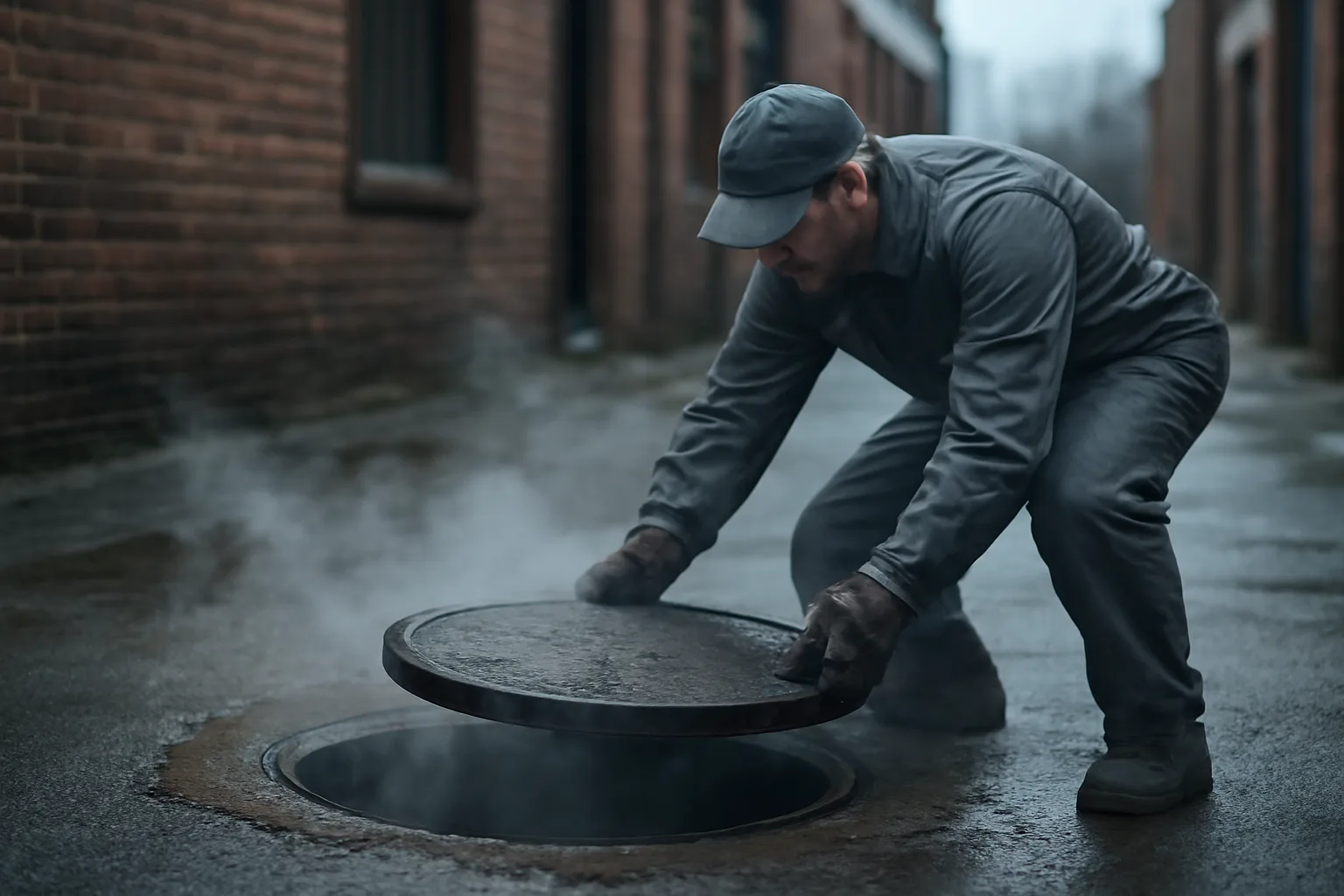
A grease trap is a plumbing tank that slows kitchen wastewater so fats, oils, and grease float and food solids settle. Clearer water leaves to the building drain or the sewer. The trapped layer is what you pump.
People use the same phrase for two hardware families. Hydromechanical units are often smaller and indoors, with a flow-control fitting. Gravity interceptors are often large outdoor tanks. Plumbing codes may call both of them interceptors. Street talk still says grease trap. If an inspector uses one word and your invoice uses the other, you still have to point at the same lid.
FOG (fats, oils, and grease) cools and congeals in pipes. It grabs rags and food scraps. That plug is a common sewer blockage. EPA estimated 23,000 to 75,000 sanitary sewer overflows a year in its 2004 Report to Congress, not counting backups into buildings. [5]
Federal pretreatment rules sit under a lot of the local FOG heat. 40 CFR 403.5 prohibits "Solid or viscous pollutants in amounts which will cause obstruction to the flow in the POTW resulting in Interference." [1] A diner is not a plating shop. A city that runs a publicly owned treatment works still has to keep grease from shutting a main.
If you cook food for the public, you likely have a grease trap, or you will be told to get one. If you pump them, that tank is the whole route.
How do you start grease trap work?
You start by picking a lane. Setting and piping a grease trap is plumbing work in most states. Pumping, hauling, and disposing of the contents is liquid waste work. Those are different boards. Mixing them up is how people buy the wrong insurance and file the wrong application.
There is no national grease trap license. EPA wrote the pretreatment frame. Your city or sanitary district runs the FOG program that actually knocks on the kitchen door. The plumbing official runs installation. A state environmental office or a city pretreatment desk runs transporter permits. Confirm forms and fees with the board that issues the paper. A national blog cannot quote your current fee.
If you are the kitchen, call the plumbing inspector and the FOG coordinator for that sewer. Ask what device they will accept, where it may sit, and what pumping interval they will check. FDA Food Code 2022 section 5-402.12 says, "If used, a grease trap shall be located to be easily accessible for cleaning." [3] That sentence shows up when someone hides a unit behind a water heater.
Want to pump? Start with disposal, not the truck. Call the plant or licensed processor that will take brown grease. Get acceptance rules in writing. Then ask the state which transporter registration covers interceptor pump-outs. Then price a used vacuum truck against real stops, not a fantasy route map.
I would not pay for a nationwide grease card. That product does not control your right to work.
Walk a real jurisdiction, not a myth. How to start grease trap in Alabama is the paper path for that state. California is a different stack. So is Alaska.
Is a grease trap the same as a grease interceptor?
In the field, yes, people mean the FOG tank. In the code book, not always. The International Plumbing Code puts grease hardware under interceptors and separators in Chapter 10. IPC 1003.1 says interceptors and separators "shall be provided to prevent the discharge of oil, grease, sand and other substances harmful or hazardous to the building drainage system, the public sewer, the private sewage disposal system or the sewage treatment plant or processes." [4]
Hydromechanical grease interceptors are rated on flow (gallons per minute) and grease capacity. Gravity grease interceptors are rated on volume. Local amendments pick which one a restaurant may use. Some FOG programs ban a tiny indoor unit as the only device for a full-prep kitchen. Some still allow it with a strict pumping contract.
Do not fight the vocabulary on the phone. Ask which standard the jurisdiction lists (often ASME A112.14.3 or PDI G101 for hydromechanical units, plus the local gravity sizing sheet). Then buy that device. A bargain unit that is not on the accepted list is a wasted crate.
| Type | Where it usually sits | How it is rated | What I'd use it for |
|---|---|---|---|
| Hydromechanical | Indoors, near the fixture | Flow and grease capacity under the standard the code names | Small kitchens, and only if the FOG program allows it |
| Gravity interceptor | Outside, in-ground | Tank volume on the local sizing sheet or IPC 1003.3 | Most full-prep restaurants in cities that want outdoor tanks |
If a salesperson says the two words are identical in every city, they are selling, not reading.
Which law actually requires a grease trap?
No single federal statute says "every fryer gets a 1,000 gallon tank." The Clean Water Act pretreatment piece is 33 U.S.C. 1317, which directs EPA to set pretreatment standards for pollutants introduced into treatment works. [11] EPA's Part 403 rules apply that idea to non-domestic wastewater going into a POTW. [10]
40 CFR 403.8 is why big plants run industrial pretreatment programs. [12] Cities then write FOG ordinances so food service establishments do not block the collection system that the plant also needs. EPA's model pretreatment ordinance is a template many local lawyers start from, not a permit you can hold in your hand. [7]
On the building side, the adopted plumbing code is the document the inspector opens. IPC Chapter 10 is one common text. [4] Massachusetts publishes its own plumbing code as 248 CMR 10, and that code has interceptor rules you actually have to read if you work there. [8] California's State Water Resources Control Board Order WQ 2022-0103-DWQ is the statewide sewer-system order that pushes agencies to control overflows, which is why FOG programs stay funded. [6]
Here is the practical answer. The requirement that can shut you down is local. Plumbing approval for the tank. FOG approval for the pumping schedule. Transporter approval for the truck. EPA's Introduction to the National Pretreatment Program is useful background. It is not your license. [2]
Do you start as a kitchen, an installer, or a pumper?
Those are three jobs. People collapse them into "starting grease trap" and then file nonsense paperwork.
A food facility starts by asking the sewer authority whether a grease trap is required for that menu and seating. Then the plumber pulls the permit. Then you sign a pumping contract the FOG office will recognize. Your paper is as-builts, the interceptor spec sheet, and pump logs.
An installer starts with a plumbing license in that state, plus any contractor registration the city wants. Grease interceptor work is still DWV plumbing. If you are not the licensee, you are a helper. I would not advertise "we set traps" on a business card that only has a hauler permit.
A pumper starts as a liquid waste transporter. Septage rules and FOG rules sometimes live in the same office and sometimes do not. Wisconsin-style septage codes, Texas sludge transporter registrations, and city FOG hauler lists are not interchangeable. Confirm the exact permit name with the board.
Want both install and pump? Budget two license paths and two insurance conversations. One truck does not make you a plumber.
State walk-throughs help you see how split this is. Compare grease trap license in Alabama with grease trap license in California. Same tank. Different desks.
What licenses and manifests do grease trap pumpers need?
Expect a transporter or liquid-waste registration from the state environmental agency, or a hauler permit from the city pretreatment office, or both. Some places also want a vehicle inspection sticker on the tank truck. Some want proof of a disposal agreement before they will stamp the application.
The manifest (trip ticket) is the document that follows the load from the kitchen lid to the plant. Many FOG programs want the facility copy left on site, the hauler copy in the truck book, and the disposal copy stamped at the receiving facility. If you cannot show that chain, you did not finish the job. You just moved a problem.
I would build the manifest habit on day one, even in a town that is still casual about it. The next ordinance update will not wait for your paperwork system to mature. If you want a form pack so you are not designing a ticket on a napkin, GreaseTrapPath sells a $199 one-time Interceptor + Manifest Kit. It does not replace the board's official form if the board prints its own.
Do not invent a federal FOG manifest number. Hazardous waste manifests under EPA's RCRA system are a different legal world. Restaurant interceptor pulp is usually brown grease, not listed hazardous waste. Treat it as the special waste your receiving plant says it is. If a load is mixed with solvents or unknown shop waste, stop and get a real characterization. Guessing is how you lose the dump site.
Alaska and Arizona are not the same window. Read how to start grease trap in Alaska and how to start grease trap in Arizona before you copy a friend's checklist from another state.
How often does a grease trap need pumping?
There is no federal pumping clock. A lot of city FOG programs use a 90 day maximum, or they use a 25 percent rule (pump when grease plus settled solids take up about a quarter of the wetted depth), or they use both. That number lives in the ordinance, not in 40 CFR 403.
Kitchens with heavy fryer load can blow past 25 percent in a few weeks. A sandwich shop with almost no prep may look clean at 90 days. The inspector does not care about your average. They care about that tank on that day.
I would pump on the stricter of the ordinance interval and the 25 percent measurement. Waiting for a smell is a bad program. By the time it smells in the dining room, the sewer may already have your grease.
Keep a dip stick or a core sampler in the truck. Write the layer thicknesses on the ticket. A ticket that only says "pumped" is weak when a FOG officer asks what you found.
Additives that claim to replace pumping are a frequent ordinance target. If a product emulsifies grease and sends it down the line, you did not solve FOG. You moved it into the main. Read the local ban list before you sell a bottle.
How is a grease trap sized?
Sizing is local math on top of a plumbing standard. IPC 1003.3 sends you through the grease interceptor sections rather than a single national gallon number. [4] Hydromechanical units are selected by flow rate and certified grease capacity. Gravity tanks are selected by volume, drainage fixture units, or a FOG program worksheet that estimates grease from the menu.
I would not size from a social media rule of thumb. Undersized tanks fail inspection and overflow. Oversized tanks that never see enough flow can go septic and still pass grease if inlets are wrong. Both waste money.
Ask the FOG office which worksheet they honor. Ask the plumbing official which listing they want on the spec sheet. Then have the plumber submit that sheet with the permit. If those two offices disagree, get the disagreement in writing before you excavate.
Manufacturers publish flow ratings. Those ratings assume a working flow-control fitting and a real maintenance interval. Yank the flow control so the sink drains faster and you have a different device than the one that was certified.
For a gravity interceptor, lid access and traffic rating matter as much as gallons. A tank under a delivery alley needs the right cover. A buried unit with no pump-out ports is a future failed inspection, which FDA's accessibility line already telegraphed. [3]
What does first-year grease trap operations look like?
Year one is routes, dump-site manners, and paper. It is not a branding exercise.
If you pump, your week is early lids, full tanks, plant lines, washouts, and ticket stacks. Rain turns outdoor interceptors into a worse job. Holiday weeks explode restaurant volume. You will be offered "emergency" work from kitchens that have not pumped in a year. Price those honestly. They clog hoses and blow your next appointment.
If you are the kitchen, year one is training dish staff not to hit the dump sink with fryer oil, plus a calendar that actually gets the pumper on site. Yellow grease (fryer oil in a rendering barrel) is not trap waste. Do not pour it in the interceptor to "get rid of it." You just filled the tank with the wrong stream.
I would spend more in year one on a reliable disposal contract and a spare pump hose than on wrap for the truck. The plant can kill your business in an afternoon. A vinyl decal cannot.
Track which accounts are 30 day accounts versus 90 day accounts. Track which lids are bolted, paved over, or hiding under a grease dumpster. That list is the real asset.
Colorado's path will not match Alabama's. If you are comparing desks, how to start grease trap in Colorado is the next click, not a national checklist.
What safety rules apply when you open a grease trap?
The tank can be a confined space. OSHA's permit-required confined space rule is 29 CFR 1910.146. [9] A gravity interceptor with a deep vault, bad air, and a lid you drop through is the kind of space that rule is about. People still treat it like a puddle. That is how rescuers end up in the hole too.
I would not put a head below the lid without air monitoring, a retrieval plan, and training that matches 1910.146. Most pump jobs should be done from grade with a vacuum hose. If you cannot break the mat without climbing in, stop and reset the job.
Gases from anaerobic FOG can include hydrogen sulfide. Splash is a face and eye problem. The load is heavy. Back injuries from yanking lids are more common than anyone writes about in FOG manuals.
Traffic is the other hazard. Outdoor tanks sit in alleys. Cones and a spotter are not optional theater. They keep a delivery van from rolling a lid over your ankles.
None of this is a substitute for your own safety program. Confirm training requirements with OSHA guidance and with whatever competent-person rule your state uses. Do not copy a YouTube "just pop the lid" clip.
Where do new grease trap operators waste money?
Buying the vacuum truck before a plant will take your waste. That is the classic hole. A pretty tank with nowhere legal to dump is scrap on wheels.
Paying for a federal grease license that does not exist. Same for framed certificates from outfits that are not the plumbing board and not the environmental agency.
Enzyme programs sold as a replacement for pumping, when the FOG ordinance still requires mechanical removal. You paid twice and you may have violated the additive ban.
Installing an indoor hydromechanical unit because it was cheap, in a city that requires an outdoor gravity interceptor for that seating count. You will dig twice.
Overbuilding software in month one. A numbered paper ticket and a photo of the open lid beat a dashboard you will not update on a wet Tuesday.
Underinsuring the truck and skipping pollution coverage because "it's only food grease." Confirm with a commercial broker who has actually written liquid-waste accounts. I will not invent a premium. Quotes move.
If a consultant promises they can get you approved on a guaranteed date, walk away. Boards do not give me (or anyone writing this) a clock they have to honor.
How does the paper path change by state?
The tank physics stay put. The desks do not.
Some states fold FOG hauling into septage licensing. Some run a separate liquid waste transporter list. Some leave hauler control to cities with pretreatment programs under 40 CFR 403.8. [12] Plumbing licenses are state issued, then locally permitted. FOG ordinances are almost always local, even when a state water board is yelling about overflows.
California's overflow order is one reason FOG programs there feel aggressive. [6] Massachusetts plumbing code is unusually specific compared with states that just adopt IPC and walk away. [8] Alaska has fewer large POTW FOG offices and more on-site system overlap. Alabama splits by county and by utility in ways that surprise people who moved from a single-city program.
Read the state guide that matches the truck's plates. Grease trap license in Alaska and how to start grease trap in California will not agree, and they should not.
Confirm every fee, quota, and processing time with the issuing board. Those numbers change, and I will not fake a current one.
What will a FOG inspector ask to see?
The interceptor. The lids. The flow control if it is a hydromechanical unit. The trap's location relative to the fixtures it claims to serve. Then the paper.
Expect pumping logs, manifests, the hauler's permit number, and a contract if the ordinance requires a licensed pumper. Kitchens that "self-clean" with a wet-vac and a dumpster are a common fail. That waste still has to go somewhere legal.
Inspectors also look for missing cleanouts, fixtures that bypass the trap, dishwashers tied in where the code or the manufacturer forbids it, and floor sinks that never got piped to the interceptor. IPC Chapter 10 is the text a lot of them grew up on. [4]
If you pump, they may ask to see the truck book on site. A stack of blank tickets looks worse than a short route.
Keep photos of the open tank with a date. Keep the plant's stamped copies. Keep the ordinance PDF so you are arguing from the same page.
GreaseTrapPath is an independent publisher, not a law firm and not a service company. If you want the Interceptor + Manifest Kit after you have read the actual board forms, it is at /start. The kit does not approve you. The board does.
Frequently asked questions
What is grease trap?
A grease trap is a tank that slows kitchen wastewater so fats, oils, and grease float and solids settle before water enters the sewer. Plumbing codes often call the same hardware a grease interceptor. Cities require them so FOG does not block pipes that lead to a publicly owned treatment works.
How do you start grease trap?
Pick a lane first. Kitchens get the device approved by the plumbing official and the FOG program. Installers need a plumbing license. Pumpers need a liquid waste transporter permit, a legal dump site, manifests, and insurance. There is no federal grease trap card. Confirm forms and fees with the board that issues them.
Do I need a federal license to pump grease traps?
No. EPA's 40 CFR Part 403 pretreatment rules explain why cities control FOG, but they are not a hauler license. Your paper comes from a state environmental agency, a city pretreatment office, or both. Anyone selling a national grease pumping license is selling decoration.
Can I install grease traps without a plumbing license?
In most states, no. Setting and piping an interceptor is plumbing. A hauler permit does not make you the plumbing contractor. Pull the permit under the licensee the state plumbing board recognizes. Local amendments decide who may cover the tank and who may connect fixtures.
Is restaurant grease trap waste hazardous waste?
Usually no, if it is ordinary brown grease from food prep. It is still regulated special waste. You take it only to a plant or processor that accepts it. If the load is mixed with solvents or unknown shop chemicals, stop and get it characterized. Do not put it in a storm drain.
How much does a grease trap pumping truck cost?
There is no honest national sticker. Used vacuum trucks trade across a wide band depending on tank size, year, and pump condition. Get current quotes. I would not buy the truck until a receiving facility has agreed in writing to take your loads and you know the transporter permit you must hold.
What is the 25 percent rule for grease traps?
Many city FOG ordinances say you must pump when grease plus settled solids fill about 25 percent of the tank's wetted depth. Some also set a maximum interval such as 90 days. It is local ordinance, not an EPA number. Measure the layers. Do not guess from the smell in the kitchen.
Can I dump grease trap waste at a landfill?
Not as a casual drop. Receiving rules belong to the wastewater plant, the processor, or a landfill that is actually authorized for that waste. Illegal dumping is the fastest way to lose a hauler permit. Get acceptance in writing before you pump the first account.
Do homes need grease traps?
Most houses do not. FOG rules target food service. A dwelling might see an interceptor only with a commercial kitchen, a special local rule, or an on-site system designer calling for one. Do not sell residential tanks from a restaurant ordinance you printed off the internet.
How long does hauler permitting take?
It depends on the board, vehicle inspection slots, and whether your disposal letter is complete. Nobody honest can guarantee a date. Confirm current processing with the issuing office. Build extra calendar time before you promise routes. A promised start date is not an approval.
What is the difference between yellow grease and trap waste?
Yellow grease is used fryer oil collected in a rendering container. Trap waste (often called brown grease) is the mixed FOG and solids pumped from the interceptor. They are different streams, different buyers, and different tickets. Pouring fryer oil into the grease trap just fills the tank and can violate the FOG program.
Do I need a manifest for every grease trap pump-out?
If the FOG program or transporter rules require trip tickets, yes, every load. Leave the facility copy, keep the hauler copy, get the disposal copy stamped. Even where enforcement is soft, a complete ticket is what you will wish you had after a spill or a complaint.
Can enzymes replace pumping a grease trap?
Not if the ordinance still requires mechanical removal, and many do. Products that emulsify grease can send FOG into the sewer, which is the outcome the trap exists to stop. Some cities ban additives. Read that section. Then keep pumping on the interval the FOG office actually checks.
Which board do I call first?
Kitchens call the plumbing inspector and the sewer FOG coordinator. Pumpers call the receiving plant first, then the state or city transporter desk. Installers call the plumbing board. If you call EPA looking for a grease trap license, you are in the wrong line.
Sources
- eCFR, 40 CFR 403.5 National pretreatment standards: Prohibited discharges: 40 CFR 403.5 prohibits solid or viscous pollutants in amounts that will cause obstruction to flow in a POTW resulting in Interference.
- U.S. EPA, Introduction to the National Pretreatment Program (EPA-833-B-11-001): EPA's National Pretreatment Program is the federal framework for controlling non-domestic pollutants discharged to POTWs.
- U.S. FDA, Food Code 2022: FDA Food Code 2022 section 5-402.12 states that if used, a grease trap shall be located to be easily accessible for cleaning.
- ICC, International Plumbing Code 2021 Chapter 10 Traps, Interceptors and Separators: IPC 1003 requires interceptors and separators to prevent oil, grease, sand, and other harmful substances from discharging to the drainage system or sewer.
- U.S. EPA, Report to Congress: Impacts and Control of CSOs and SSOs (EPA 833-R-04-001, 2004): EPA estimated at least 23,000 to 75,000 sanitary sewer overflows per year, not including sewage backups into buildings.
- U.S. EPA, Model Pretreatment Ordinance (January 2007): EPA published a model pretreatment ordinance that local governments use as a starting template for industrial user and related local controls.
- Massachusetts 248 CMR 10.00 Uniform State Plumbing Code: Massachusetts publishes interceptor and plumbing rules in 248 CMR 10, which is the state code installers and inspectors there actually open.
- OSHA, 29 CFR 1910.146 Permit-required confined spaces: OSHA's permit-required confined space standard (29 CFR 1910.146) is the federal rule that applies when a worker would enter a space such as a deep interceptor vault.
- eCFR, 40 CFR 403.1 Purpose and applicability: 40 CFR Part 403 implements Clean Water Act pretreatment provisions for pollutants from non-domestic sources introduced into POTWs.
- U.S. Code, 33 U.S.C. 1317 Pretreatment standards: 33 U.S.C. 1317 is the Clean Water Act section that directs pretreatment standards for pollutants introduced into publicly owned treatment works.
- eCFR, 40 CFR 403.8 Pretreatment program requirements: Development and implementation by POTW: 40 CFR 403.8 is the federal rule that requires many POTWs to develop and implement pretreatment programs, which is why local FOG and industrial user controls exist.