Last updated 2026-08-18
TL;DR
To start a grease trap pumping business in Alabama you need a state plumbers license or a specialty liquid-waste hauler registration, a commercial vehicle, liability insurance, and a manifest system for every load. Startup costs run roughly $15,000 to $80,000 depending on whether you buy a new pump truck. Plan on two to four months before your first legal job.
What is a grease trap business and what does it actually do in Alabama?
A grease trap business pumps the fats, oils, and grease that build up in the underground interceptors restaurants, hotels, and food processors are required to install under most Alabama municipal codes. You pull the waste, haul it to an approved treatment facility, and document every load with a manifest. That paper trail is the job. Regulators in Alabama care about two things: are you licensed to work on the plumbing device, and can you prove where the waste went?
Alabama does not have a single statewide "grease trap pumper" license the way some states do. The requirement lands on you from two directions at once. First, the Alabama State Plumbing Board controls who can physically install, clean, and service grease interceptors as plumbing fixtures. Second, the Alabama Department of Environmental Management (ADEM) governs the liquid industrial waste you generate the moment you pump it into your truck. You need to satisfy both before you take a paying customer.
The market is real. Local sewer authorities enforce pretreatment standards that push food service grease into private haulers through mandatory pump-out schedules [1]. Birmingham, Huntsville, Montgomery, and Mobile all run FOG (fats, oils, grease) control ordinances that create recurring, contractual demand for licensed pumpers.
Do you need a license for grease trap work in Alabama?
Yes, and it is at least two licenses, and potentially three depending on how you structure your work.
The Alabama State Plumbing Board requires anyone who cleans, services, or repairs a grease interceptor as a plumbing fixture to hold a valid plumbing contractor or journeyman license, or to work under one [2]. The board administers exams and issues contractor licenses that let you run your own shop. If you plan to hire techs who touch the trap itself, they need coverage under your contractor license or their own journeyman cards.
ADEM separately regulates liquid waste haulers. Any vehicle transporting grease trap waste (classified as liquid industrial waste under Alabama's solid waste rules) must be registered with ADEM's Land Division and operate under a permit [3]. You apply for a Liquid Industrial Waste Hauler permit and renew it annually. The permit ties to your vehicle more than your company, so each truck needs its own paperwork.
Some municipalities add a third requirement: a local business license or a city-level hauler registration. Birmingham's pretreatment program, for instance, expects haulers servicing restaurants inside the city sewer district to be on an approved list [6]. Call the sewer authority in each county you plan to work before you assume your state credentials are enough.
Confirm current fees and exam schedules directly with the Alabama State Plumbing Board and ADEM. Both adjust their numbers periodically, and a printout from last year is not proof of this year's cost.
What are the Alabama plumbing license requirements for grease trap work?
The Alabama State Plumbing Board issues four main license classes: Master Plumber, Journeyman Plumber, Restricted Plumber, and Plumbing Contractor [2]. For a grease trap business, the practical path is a Plumbing Contractor license so you can run jobs and employ journeymen. To qualify, you typically need documented work experience (the board specifies hours; confirm the current requirement directly), a passing written exam, and a surety bond.
If you already hold a journeyman card in Alabama, you have field credentials but you still need the contractor license to operate as a business and sign off on jobs. Coming in fresh with no plumbing background means a longer runway. Some new operators hire a licensed master plumber as a qualifying agent while the owner builds credentials. That arrangement is legal but adds payroll cost, so price it into your startup budget.
Exam prep runs through the International Association of Plumbing and Mechanical Officials (IAPMO) and the Plumbing-Heating-Cooling Contractors Association (PHCC). The Alabama board accepts specific exam providers. Check their current approved list before you pay for a course.
One thing trips people up: the license is individual, not corporate. Your company does not hold it. A named person does. If that person leaves, your operating authority evaporates until you add a new qualifying license holder. Build that into how you structure the business from day one.
How do you register as a liquid waste hauler with ADEM?
ADEM's Land Division handles permits for companies that transport liquid industrial waste, which includes grease trap pumpings [3]. The application asks for company information, a description of each vehicle (make, model, tank capacity, VIN), proof of insurance, and identification of your disposal site. ADEM needs to know where the waste is going before they issue a permit, so line up a receiving facility first.
Receiving facilities in Alabama include permitted wastewater treatment plants that accept high-strength organic waste and commercial waste processors. Not every municipal plant takes it. Call ahead. Get a written acceptance letter because ADEM will ask for it.
The permit has to be renewed. Vehicles added after initial approval need an amendment. Buy a second truck six months in, and you cannot use it for liquid waste until you have updated your permit to include that VIN. ADEM inspectors check this.
ADEM's Land Division can be reached at (334) 271-7730 [3]. State fees are set by rule and have historically been modest, but confirm the current schedule at the time you apply.
What vehicle and equipment do you actually need?
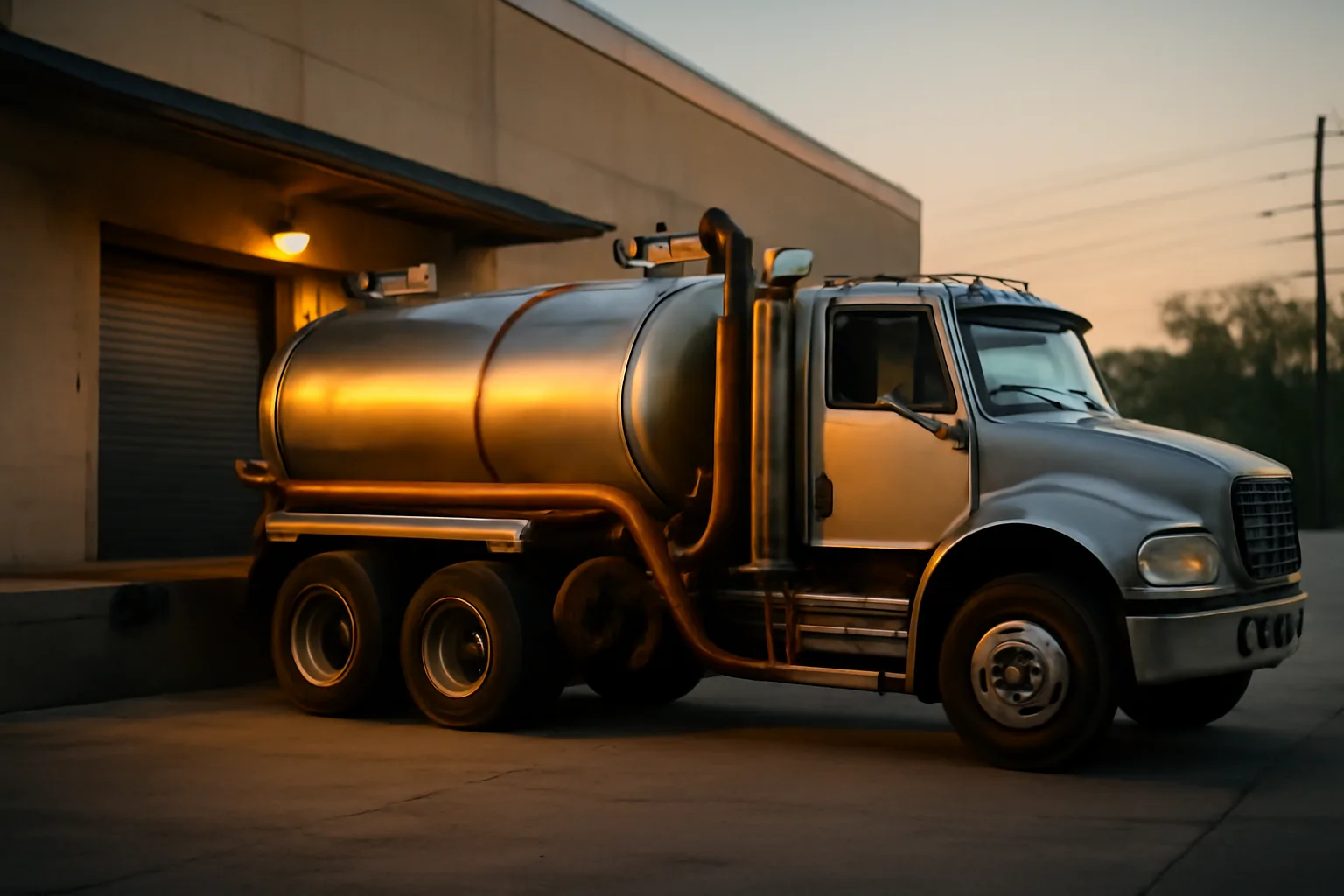
The core piece of equipment is a vacuum pump truck with a sealed waste tank. For grease trap work, typical tank sizes run from 1,500 to 4,000 gallons. A smaller 1,500-gallon unit on a used commercial chassis might cost $18,000 to $35,000; a new purpose-built truck from a manufacturer like Ledwell, GapVax, or Cusco runs $80,000 to $150,000 or more [4]. Used equipment drops your entry cost but raises maintenance risk. Most first-year operators buy used and keep the difference for insurance and working capital.
Beyond the truck you need:
- Hoses rated for grease and organic waste, typically 3-inch to 4-inch diameter
- Jetting or hydro-flush capability if you plan to clean trap baffles (many operators skip this at startup)
- A calibrated flow meter or volume gauge so your manifests are accurate
- Personal protective equipment: gloves, goggles, rubber apron, respirator for confined-space-adjacent work
- Spill kit and containment materials required by ADEM
Your truck also needs DOT compliance if it crosses federal weight thresholds or hauls hazardous-adjacent materials. Check with the Alabama Law Enforcement Agency (ALEA) Motor Carrier Division for commercial vehicle registration and IFTA fuel tax enrollment if you plan to cross state lines [5].
Building out your paperwork systems at startup? GreaseTrapPath's Interceptor + Manifest Kit bundles the core manifest templates and licensing checklists into a single one-time purchase at $199, cheaper than the hourly rate of a consultant who will tell you the same thing.
How much does a grease trap business cost to start in Alabama?
Startup costs in Alabama split into three buckets: licensing, equipment, and operations.
| Cost item | Low estimate | High estimate | Notes |
|---|---|---|---|
| Plumbing contractor license (exam + fees) | $200 | $600 | Confirm current fee with Alabama Plumbing Board |
| ADEM liquid waste hauler permit | $100 | $400 | Per vehicle; confirm with ADEM |
| Surety bond (plumbing contractor) | $300 | $800/yr | Based on typical $10K-$25K bond amounts |
| General liability insurance | $2,400 | $6,000/yr | $1M per occurrence is a common floor |
| Commercial auto (pump truck) | $3,600 | $9,000/yr | Vacuum trucks are rated higher than standard commercial |
| Used vacuum truck (1,500-2,500 gal) | $18,000 | $45,000 | Market prices vary widely by age and condition |
| New vacuum truck | $80,000 | $150,000+ | New purpose-built units |
| Hoses, PPE, spill kit, tools | $1,500 | $4,000 | |
| Business formation (LLC) + registered agent | $200 | $500 | Alabama SOS filing fee plus agent if used |
| Manifest system and compliance software | $0 | $1,200/yr | Paper manifests are legal; software adds route tracking |
| Working capital (fuel, disposal fees, payroll) | $5,000 | $15,000 | First 60-90 days |
Buy a used truck in reasonable shape and your all-in startup cost is realistically $30,000 to $60,000. Go new and budget $120,000 to $180,000. Neither figure includes your own living expenses while the business ramps.
Disposal fees at the receiving facility add a per-load variable cost, typically $0.04 to $0.12 per gallon depending on the facility and volume, though nobody has great public data on Alabama-specific rates. Get quotes from two or three facilities before you price your customer contracts [4].
On the revenue side, grease trap pumping in the Southeast typically bills at $150 to $400 per service visit for a standard restaurant trap, with larger industrial interceptors going higher. A solo operator running four to six stops a day on a tight route can clear $2,000 to $3,500 in gross revenue on a good day, which is why the economics work even with a modest used truck.
How long does it take to start a grease trap business in Alabama?
Two to four months is the honest range, assuming no major delays. Here is roughly how the time stacks up.
Weeks 1 to 2: Form your LLC with the Alabama Secretary of State (usually one to three business days online), get an EIN from the IRS (same day online) [10], open a business bank account.
Weeks 2 to 6: Study for and schedule the Alabama plumbing contractor exam. The board sets exam dates. There is no walk-in option. Miss a testing window and you wait for the next one. This is usually the longest single variable in the timeline.
Weeks 3 to 8: Locate and buy (or finance) your vacuum truck. Used truck sourcing can take two to six weeks depending on your market. Do not skip the pre-purchase inspection.
Weeks 4 to 10: Apply for your ADEM liquid waste hauler permit. Processing time at ADEM has historically run three to six weeks after a complete application, but confirm current timelines with the agency directly because backlogs vary [3].
Weeks 6 to 12: Bind insurance, register the vehicle with ALEA, set up your manifest system, get your disposal facility agreement in writing, apply for any local business licenses in your operating counties.
The critical path is almost always the plumbing board exam schedule plus ADEM permit processing running in parallel. Miss an exam date by one week and you might add a full month. Start both processes early and do not wait for one to finish before starting the other.
What is the manifest requirement for grease trap waste in Alabama?
Every load of grease trap waste you haul must be documented with a manifest, sometimes called a waste hauler manifest or a liquid waste manifest. This is not optional and it is not paperwork you can deal with later. ADEM requires it, most municipal pretreatment programs require it, and your disposal facility will not accept the waste without it [3].
A proper manifest records the generator (the restaurant or facility you pumped), the generator's address, the volume pumped, the date and time, your company and permit number, the driver's name, and the destination facility. The receiving facility signs it when you deliver, and you keep copies. ADEM can ask to see manifests going back years during an inspection.
Some counties and municipalities in Alabama run their own manifest forms on top of the state requirement. Birmingham's sewer authority, for example, tracks FOG waste through its pretreatment program and expects hauler documentation that matches their tracking system [6]. Sign up a new customer in a new municipality, and your first call is to the sewer authority asking what format they want.
Paper manifests are fully legal in Alabama. Electronic systems exist and make route management easier as you scale, but at startup a well-designed paper form works fine. The key is consistency: same format every time, no blank fields, copies retained.
What insurance does a grease trap business need in Alabama?
You need at minimum four types of coverage before you take a paying job.
General liability covers bodily injury and property damage at the customer's site. A $1 million per-occurrence, $2 million aggregate policy is the standard floor most commercial customers and municipalities accept. Some contracts require $2 million per occurrence. Annual premiums for a one-truck grease trap operation in Alabama typically run $2,400 to $6,000 depending on the carrier, your claims history, and your revenue [4].
Commercial auto covers the pump truck. Vacuum trucks with waste tanks are rated as specialty vehicles and cost more to insure than a standard cargo van. Expect $3,600 to $9,000 per year per truck. Add drivers and premiums go up.
Pollution liability (sometimes called contractor's pollution liability or CPL) covers spills and environmental contamination. Grease trap waste is organic but it is still a pollutant if it reaches a waterway or groundwater. Some general liability policies explicitly exclude pollution events. Read your GL policy exclusions carefully and ask your broker about a stand-alone CPL endorsement. Annual premiums for small haulers run $800 to $2,500.
Workers' compensation is required in Alabama if you have one or more employees [7]. A sole operator with no employees may be exempt, but confirm the current rule with the Alabama Department of Labor.
The Alabama State Plumbing Board also requires a surety bond as part of contractor licensing. That is not insurance for you. It protects your customers. But it is a real cost and you need it in place before the board will issue your contractor license.
How do you find your first customers in Alabama?
Every food service establishment in Alabama that connects to a public sewer and has a grease-producing kitchen is a potential customer. The municipal pretreatment programs practically hand you a customer list if you know how to read it.
Start by contacting the sewer authority in your target city and asking for their FOG control ordinance and any public list of permitted food service establishments. Many authorities keep a database. They may not hand over the whole list on request, but the FOG coordinator will often tell you which parts of town have the highest density of required pump-outs.
Direct outreach works better than most people expect in this business. Walk into restaurants, speak to the kitchen manager or owner, show your license and permit credentials, and give a clear price per service. Independent restaurants make faster decisions than chains. Chains route purchasing through corporate, which takes longer but locks in volume once you get approved.
Most grease trap service contracts in the South run on a quarterly or monthly schedule. A restaurant with a 1,000-gallon trap on a monthly contract is $150 to $300 per month in predictable recurring revenue. Get 20 of those and you have a real business.
Comparing Alabama's regulatory environment to neighboring states? The framework here is similar in structure to Arkansas and Georgia but lighter than some larger states. See our guide on how to start grease trap in Arkansas if you're thinking about operating across state lines.
What are the ongoing compliance obligations after you open?
Opening is the easy part. Staying compliant is the job.
Your ADEM liquid waste hauler permit renews annually. Set a calendar reminder 60 days before your renewal date so you are not scrambling. Add trucks, and you amend the permit before the new vehicle hauls a drop.
Your Alabama plumbing contractor license also renews on a schedule set by the board, and continuing education requirements may apply. Check the current CE requirements directly with the board when you receive your initial license.
Manifests must be retained for the period ADEM specifies, typically three years, though confirm the current requirement. Keep them organized by customer and date. An ADEM inspector can show up unannounced.
Haul across state lines and each state has its own hauler permit requirement. Georgia, Tennessee, Mississippi, and Florida all run separate programs. Do not assume your Alabama credentials transfer.
Review your disposal facility agreement annually too. If the facility changes ownership, loses its permit, or changes pricing hard, you need a backup option. An operator without a permitted disposal site cannot legally haul.
Local business licenses typically renew annually. Birmingham, Huntsville, Montgomery, and Mobile each have their own renewal calendars and fees. Mark those dates.
For a closer look at the licensing side specifically, our grease trap license in Alabama guide covers the plumbing board and ADEM permit details with more granular exam prep information.
GreaseTrapPath's Interceptor + Manifest Kit at /start includes a compliance calendar template and manifest forms designed for Alabama's dual-agency structure, for a one-time $199 fee.
Frequently asked questions
Do you need a license for grease trap work in Alabama?
Yes. You need a plumbing contractor or journeyman license from the Alabama State Plumbing Board to physically service grease interceptors, and a separate liquid waste hauler permit from ADEM for every truck that transports the pumped waste. Some municipalities add a local hauler registration on top of those two. Confirm current requirements with each agency before you start.
How much does it cost to start a grease trap business in Alabama?
If you buy a used vacuum truck, total startup costs run roughly $30,000 to $60,000, covering the truck, licenses, insurance, bond, and first-month operating costs. A new truck pushes that range to $120,000 to $180,000 or more. Annual licensing and insurance costs after year one typically run $7,000 to $16,000 depending on fleet size and coverage limits.
How long does it take to get licensed and operational in Alabama?
Two to four months is a realistic timeline. The Alabama plumbing board exam schedule is usually the longest single variable because you have to wait for a scheduled test date. ADEM liquid waste hauler permit processing adds three to six weeks after a complete application. Running both applications in parallel is the fastest path.
What is ADEM's role in grease trap hauling in Alabama?
The Alabama Department of Environmental Management regulates grease trap waste as liquid industrial waste under its Land Division permit program. Any vehicle transporting that waste must hold an ADEM liquid waste hauler permit tied to the specific vehicle's VIN. ADEM also enforces manifest recordkeeping and can inspect your records at any time.
Do I need a separate permit for each truck?
Yes. ADEM's liquid waste hauler permit ties to each vehicle by VIN. If you add a second truck, you must amend your permit before that truck legally hauls grease trap waste. Operating an unpermitted vehicle can result in fines and permit revocation for your whole operation.
Can I start a grease trap business in Alabama without a plumbing license?
Not if you are cleaning or servicing the trap itself. The Alabama State Plumbing Board treats grease interceptors as plumbing fixtures, so anyone who opens, pumps, or services one needs to be a licensed plumber or work under a licensed plumbing contractor. You could hire a qualifying licensee while you build your own credentials, but that adds cost.
Where does the waste go after I pump a grease trap in Alabama?
Grease trap waste must go to an ADEM-permitted receiving facility, typically a wastewater treatment plant that accepts high-strength organic waste or a licensed commercial processor. You must have a written agreement with your disposal facility before ADEM issues your hauler permit, and you must document every delivery with a signed manifest.
What kind of insurance does a grease trap hauler need in Alabama?
At minimum: general liability ($1M per occurrence is a common floor), commercial auto for your vacuum truck, and pollution liability to cover spills. Workers' compensation is required if you have any employees. Some municipal contracts require higher liability limits. Get quotes from carriers that specialize in environmental or contractor operations, not standard small-business carriers.
Do Alabama municipalities have their own grease trap rules on top of state rules?
Yes, and they vary. Birmingham, Huntsville, Montgomery, and Mobile all have FOG control ordinances that set pump-out frequencies for food service establishments and may require haulers to be on an approved list. Always call the local sewer authority in any county you plan to service and ask about their specific requirements before signing customer contracts.
How do I find grease trap customers in Alabama?
Food service establishments connected to a public sewer are your market. Start with direct outreach to independent restaurants in your target area. Contact the local sewer authority's FOG coordinator for information on required pump-out schedules in their district. Most grease trap contracts are recurring quarterly or monthly, so even a small customer base builds predictable revenue quickly.
Is there a statewide grease trap pumping license in Alabama?
Not a single dedicated one. Alabama routes grease trap licensing through the State Plumbing Board (for the physical service work) and ADEM (for waste transport). There is no single "grease trap pumper" credential the way some other states have structured it. You need both agencies' approvals to operate legally.
What records do I need to keep as a grease trap hauler in Alabama?
You must retain a manifest for every load hauled, recording the generator, volume, date, your permit number, driver, and receiving facility signature. ADEM typically requires retention for at least three years, though confirm the current requirement directly. Local pretreatment programs may have their own record formats and retention rules on top of the state requirement.
Can I operate a grease trap business in Alabama and neighboring states at the same time?
Yes, but each state has its own hauler permit program. Georgia, Tennessee, Mississippi, and Florida all require separate permits for liquid waste transport. Your Alabama ADEM permit does not transfer. If you plan cross-border routes, budget time and fees for each state's application process before hauling across any state line.
What is the Alabama plumbing contractor exam like?
The Alabama State Plumbing Board administers a written exam covering plumbing codes, safety, and business law. Exams are scheduled at specific dates, not on-demand. Approved exam prep providers include IAPMO and PHCC-affiliated courses. Check the board's current approved provider list and testing calendar directly before you pay for any prep materials.
Sources
- U.S. EPA, National Pretreatment Program: Local sewer authorities enforce pretreatment standards including FOG control that drives mandatory pump-out schedules and demand for licensed grease trap haulers.
- Alabama Department of Environmental Management (ADEM), Land Division: ADEM requires a liquid waste hauler permit for every vehicle transporting grease trap waste; manifests and disposal site documentation are required.
- National Onsite Wastewater Recycling Association (NOWRA): Vacuum pump truck prices, disposal fee ranges, and general liability insurance cost ranges for liquid waste haulers.
- Alabama Law Enforcement Agency (ALEA): Commercial vehicles in Alabama including vacuum trucks must comply with ALEA Motor Carrier registration requirements.
- Birmingham Water Works: Birmingham's pretreatment program tracks FOG waste haulers and expects hauler manifest documentation consistent with their tracking system.
- Alabama Department of Labor, Workers' Compensation Division: Workers' compensation coverage is required in Alabama for employers with one or more employees.
- U.S. EPA, Controlling FOG Discharges from Food Service Establishments: Food service establishments produce large volumes of grease-laden wastewater regulated under the NPDES pretreatment framework.
- IRS, Employer Identification Number (EIN) Application: EIN can be obtained same-day online through the IRS for new business entities.