Last updated 2026-08-18
TL;DR
Starting a grease trap pumping business in Alaska means getting authorization under Alaska DEC's solid waste rules (18 AAC 60), a state business license through DCCED, and meeting local pump-out manifest requirements. Startup costs run roughly $5,000 to $80,000, depending on whether you buy a vacuum truck. Approvals take 4 to 12 weeks, varying by borough.
What does a grease trap business actually do in Alaska?
A grease trap business pumps fats, oils, and grease (FOG) out of the interceptors installed under restaurants, food processors, and commercial kitchens, then hauls that waste to an approved disposal site. In Alaska, the waste usually lands at a licensed septage receiving station or a municipal wastewater treatment plant that accepts FOG.
The state is huge and the infrastructure is thin. Outside Anchorage, Fairbanks, and Juneau, you might be the only hauler serving an entire region. That's an opportunity and a headache at the same time. A cafe in a remote town still needs a compliant pump-out; the twist is you could be driving 200 miles round-trip on gravel to do one job.
Work out the disposal chain before you write a single check. Call the nearest treatment plant or permitted disposal site and confirm two things: that they accept FOG waste, and at what volume. If they don't, your business model is broken until you fix it.
Do you need a license for grease trap pumping in Alaska?
Yes. You need at least two registrations running at once before you touch a grease trap commercially.
First, a State of Alaska Business License from the Department of Commerce, Community, and Economic Development (DCCED). This is the baseline license for any business operating in the state. The biennial fee is $50 for most business types, and you apply through the DCCED online portal [1].
Second, and specific to this industry, you need to comply with Alaska's solid waste rules. The Alaska Department of Environmental Conservation (DEC) regulates land disposal of septage, grease trap waste, and other non-hazardous liquid waste under 18 AAC 60, the Solid Waste Management regulations [2]. Haulers moving grease trap waste have to follow these rules, and in many cases need a permit or registration to run a disposal facility or transport waste to one.
DEC's Division of Water enforces pretreatment and FOG program requirements for facilities discharging to municipal systems under 18 AAC 72 [3]. If you dispose at a municipal plant, that plant's pretreatment coordinator will want to see your hauler credentials before accepting a load.
Local borough and municipality rules sit on top of all of this. Anchorage runs its own FOG control program through Anchorage Water and Wastewater Utility (AWWU), which requires licensed haulers to use approved manifests for every pump-out [4]. Fairbanks and Juneau have their own versions. Confirm exactly what your borough requires before you operate.
Planning to clean or inspect the equipment, more than pump it? Some municipalities want a plumber's license or a contractor registration for that. Different track. Check with your borough's building safety office.
See the full breakdown of Alaska-specific licensing at grease trap license in alaska.
What are the step-by-step startup requirements in Alaska?
Here's the sequence that works on paper and in the field.
Step 1: Choose your business structure. Sole proprietor, LLC, or corporation. Most operators pick an LLC for the liability shield. Register with DCCED's Corporations, Business and Professional Licensing division [1]. The Alaska LLC filing fee is $250; confirm the current amount at the DCCED site before filing.
Step 2: Get your Alaska Business License. Same DCCED portal, $50 biennial fee. You need this before you can do almost anything else officially.
Step 3: Lock down your disposal outlet. Contact the receiving facility in writing. Get their hauler requirements in writing too. This step takes longer than people expect, and it's the one that kills business plans in rural Alaska.
Step 4: Register with DEC as a waste hauler if required. Read 18 AAC 60 and call DEC's Solid Waste Program to find out whether your operation needs a permit, a registration, or just compliance documentation [2]. The answer depends on your waste volume and disposal method.
Step 5: Buy or lease your vacuum truck. The vehicle has to meet DOT requirements for hauling liquid waste and needs a tank sized for the volumes you'll handle. Costs are below.
Step 6: Set up your manifest system. Every pump-out needs a record on paper or electronic: the generator's name and address, the volume pumped, the waste type, and the receiving facility. Non-negotiable for any municipality with a FOG program [4]. The manifest is also your proof of service if a restaurant disputes a job or a regulator audits you.
Step 7: Get insured. Liquid waste haulers in Alaska typically carry general liability, commercial auto, and sometimes pollution liability. Full section below.
Step 8: Land contracts. Start with restaurants and commercial kitchens near you. Many already have a pump-out frequency written into their local FOG ordinance, so they need you. You just have to find them.
For how neighboring states structure this, see how to start grease trap in arizona and how to start grease trap in california.
How much does grease trap pumping startup cost in Alaska?
Cost depends almost entirely on the truck: buying one outright, leasing, or starting as a subcontractor hauling for an existing operation.
| Expense | Low estimate | High estimate | Notes |
|---|---|---|---|
| Business license (biennial) | $50 | $50 | DCCED, confirm current fee [1] |
| LLC formation | $250 | $250 | DCCED filing fee, confirm current fee [1] |
| DEC permits/registrations | $0 | $500+ | Depends on operation type; confirm with DEC [2] |
| Used vacuum truck (2,500 to 3,000 gal) | $25,000 | $60,000 | Alaska used market; condition varies widely |
| New vacuum truck | $80,000 | $200,000+ | New units with Arctic package; freight adds cost |
| Vehicle DOT inspection and compliance | $500 | $2,000 | Pre-purchase inspection strongly recommended |
| Insurance (annual) | $4,000 | $12,000 | General liability + commercial auto; pollution riders add more |
| Manifests, forms, software | $200 | $1,500 | Paper systems are cheap; electronic manifests vary |
| Initial marketing and contracts | $500 | $3,000 | Website, business cards, direct outreach |
| Working capital buffer | $5,000 | $15,000 | Cover fuel, disposal fees, payroll for first 60 days |
The truck is the biggest variable. Alaska adds cold-weather gear on top: tank heaters, insulated hose, sometimes heated storage for the vehicle through winter. An Arctic package on a new truck can add $10,000 to $20,000.
Disposal fees are the cost people underestimate. If a municipal plant charges a per-gallon rate to accept FOG waste, that eats your margin on every single job. Get those rates in writing before you build your pricing.
Nobody has clean statewide data on Alaska grease trap startup costs. The ranges above come from commercial truck pricing and published fee schedules where they exist. Treat the truck numbers as a starting point; the used market in Alaska is thin enough that prices swing hard.
If you want help with the paperwork, GreaseTrapPath's Interceptor + Manifest Kit ($199 one-time) covers the manifest templates, hauler registration checklists, and disposal documentation forms most first-year operators need.
How long does grease trap licensing take in Alaska?
The state business license through DCCED usually issues within a few business days for complete online applications [1]. LLC formation runs 2 to 5 business days online, longer by mail.
The DEC piece is harder to pin down. If your operation needs a formal solid waste permit rather than a registration or compliance certification, processing time depends on DEC's workload and how complete your application is. DEC publishes no hard statutory deadline for solid waste hauler registrations. Call the Solid Waste Program and ask for an estimated turnaround before you commit to a start date.
Local approvals are the wildcard. Anchorage's AWWU FOG program requires haulers to get on the approved list before submitting manifests, and that means sending documentation and waiting for staff review [4]. Juneau and Fairbanks have similar but not identical processes.
Realistic total for a new operator in a major Alaska city: 4 to 8 weeks if everything's in order and you answer requests fast. In a rural borough with thin staffing and more back-and-forth, 8 to 12 weeks is common. Don't sign a lease on a yard or commit to customer contracts until you have confirmation from DEC and your local municipality.
What insurance do Alaska grease trap haulers need?
Alaska does not publish a single statewide minimum insurance requirement specific to grease trap haulers the way some states do. What you actually need comes from three directions.
Commercial auto insurance is required for any vehicle operating on Alaska roads under the state's Motor Vehicle Safety Responsibility Act, AS 28.22.011, which sets minimum liability limits [5]. For a vacuum truck those limits are a floor, not a ceiling. Your lender or yard landlord may demand more.
General liability insurance is standard practice and most commercial customers require it before they sign. A $1 million per-occurrence limit is typical in this industry.
Pollution liability (also called environmental liability) is the coverage operators skip and later regret. If a hose fails and FOG waste hits a parking lot or runs into a storm drain, your general liability policy probably won't cover the cleanup. Pollution riders and standalone pollution policies exist specifically for liquid waste haulers. Premiums swing widely by carrier and loss history.
Get quotes from carriers who specialize in environmental or waste industry accounts. General commercial brokers often don't know this product well.
What equipment do you actually need to start?
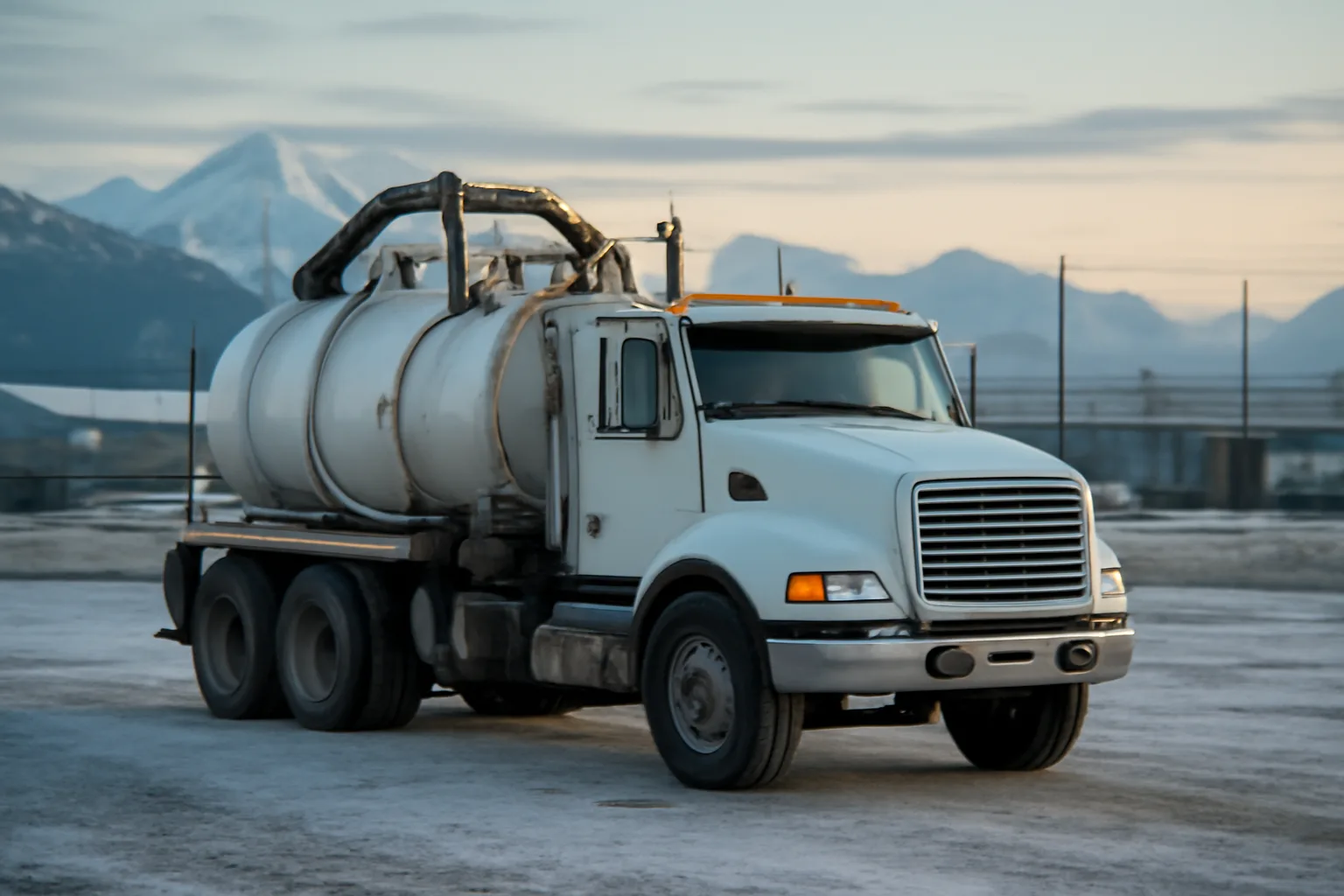
The core piece is a vacuum truck with a tank sized for your market. In Alaska, the tank-size math flips compared to the lower 48: if you're driving two hours between jobs, you want fewer trips to the disposal site, which favors bigger tanks. A 2,500 to 3,000-gallon unit is a common start for operators covering a mid-size city. Rural-route operators sometimes run 4,000+ gallon tanks.
Beyond the truck, you need:
- Vacuum hose and fittings in lengths that fit your job sites (grease traps sometimes hide in basements or awkward back-of-house corners)
- Cold-weather hose and fittings rated for temperatures that actually happen in Alaska (standard rubber hose can fail at -20°F)
- A tank heater or insulation system so waste doesn't solidify in the tank
- Basic hand tools for trap lids and fittings
- Spill containment materials (absorbent pads, a small containment tray) for the inevitable drips
- A manifest book or electronic manifest system
If you work an area where FOG freezes solid in the interceptor during winter (common in northern Alaska), you may also need hot water jetting capability. Without it you'll be turning away calls from January through March.
Alaska equipment differences are real enough that buying a used truck from a lower-48 dealer without inspecting it in person is a gamble. Get a pre-purchase inspection from a diesel shop in Alaska that knows the climate.
How do Alaska's environmental regulations affect grease trap haulers?
Alaska's solid waste regulations under 18 AAC 60 set the framework for how non-hazardous liquid waste, grease trap contents included, gets collected, transported, and disposed [2]. The rules set standards for disposal facility operation and waste characterization.
DEC's Division of Water runs pretreatment programs under 18 AAC 72, which is the regulatory home for FOG control at facilities discharging to municipal sewers [3]. You're the hauler, not the generator, but the generator's compliance record ties to yours. If you don't provide proper pump-out documentation, the restaurant can't prove compliance, and you lose the account.
EPA's pretreatment regulations at 40 CFR Part 403 sit above the state program [6]. Alaska administers EPA-approved programs as a primacy state, but federal standards are the floor.
Haulers are responsible for making sure waste goes only to facilities authorized to receive it. That responsibility matters: if you dump FOG waste at an unauthorized site, even by mistake, you're the one holding the liability.
How do manifest and record-keeping requirements work in Alaska?
Every grease trap pump-out in a municipality with a FOG program requires a manifest. The manifest documents the generator (the restaurant), the hauler (you), the volume pumped, the date, and the receiving facility. Both the generator and the hauler keep copies.
Anchorage Water and Wastewater Utility's FOG control program requires haulers to submit pump-out records, and approved haulers must use the correct form formats [4]. Other municipalities run similar but not always identical requirements. Confirm the specific form with your local utility before you start.
Keep manifests for at least three years. If a generator gets cited for a missing pump-out, your manifest is the proof the work was done. Losing that documentation is a business risk you don't want.
Electronic manifest systems exist and some municipalities accept them, but paper still works everywhere. Starting out, a well-organized paper manifest book is fine. The GreaseTrapPath Interceptor + Manifest Kit at /start includes manifest templates formatted to common municipal requirements, which saves you the back-and-forth of figuring out what fields each form wants.
For how other states handle this paperwork, the how to start grease trap in alabama and how to start grease trap in arkansas guides cover regional variation in manifest formats.
What does a realistic first year of operations look like?
Months one through three are mostly setup and slow revenue. You're finishing registrations, getting insured, finding first customers, and learning your disposal site's intake procedures. Expect a handful of jobs, some at break-even or below, while you build a route.
Months four through six, if you did the outreach, recurring accounts start showing up. Restaurant grease traps need pump-outs on a schedule, monthly to quarterly depending on trap size and kitchen volume. Recurring accounts are the asset here. One-time calls are fine, but a route of 30 restaurants on monthly contracts is what makes the math work.
Year-one revenue is genuinely hard to predict in Alaska because market size swings so much by location. An Anchorage operator with a solid route can bill $8,000 to $15,000 per month. An operator serving a smaller community might bill $2,000 to $5,000 per month. Nobody has published clean statewide data; those ranges reflect industry discussion and job pricing typical for the Pacific Northwest and Alaska.
The costs that ambush first-year operators: fuel (Alaska prices run above the national average, and vacuum trucks get single-digit miles per gallon), disposal fees at receiving facilities, and maintenance. A vacuum pump rebuild on a high-use truck runs $3,000 to $8,000.
Curious how the startup arc looks in a state with more established infrastructure? See how to start grease trap in colorado.
Key state contacts and where to start your applications
Here's where to actually go.
Alaska DCCED, Corporations, Business and Professional Licensing: online business license applications and LLC filings [1]. Start here for your business entity and state business license.
Alaska DEC, Solid Waste Program: hauler registration questions and 18 AAC 60 compliance [2]. Call the Anchorage or regional office and ask specifically about grease trap waste hauler requirements for your location.
Alaska DEC, Division of Water: pretreatment and FOG questions under 18 AAC 72 [3].
Anchorage Water and Wastewater Utility (AWWU): FOG hauler approval if you operate in the Anchorage service area [4].
Your local borough's planning and zoning office: any zoning or conditional use permit for your yard or storage area.
Alaska DMV: commercial vehicle registration and CDL requirements for your vacuum truck [7].
Call before you assume. Alaska's regulatory picture isn't always fully reflected online, and the person on the phone often has practical guidance no document holds.
Frequently asked questions
Do you need a license for grease trap pumping in Alaska?
Yes. At minimum you need a State of Alaska Business License from DCCED and must comply with DEC solid waste hauler regulations under 18 AAC 60. Local municipalities like Anchorage add their own FOG hauler approval requirements. If your operation involves disposal facility management or large volumes, a DEC solid waste permit may also apply. Confirm specifics with DEC and your local municipality before operating.
How much does it cost to start a grease trap business in Alaska?
Startup costs run from roughly $5,000 (subcontracting model, minimal equipment) to $80,000 or more (buying a used vacuum truck outright). A new truck with an Arctic cold-weather package runs $80,000 to $200,000 or more. Add insurance ($4,000 to $12,000 annually), state and local fees, and a working capital buffer. Fuel and disposal fees are ongoing costs that hit margins hard in Alaska's large-geography market.
How long does grease trap licensing take in Alaska?
The state business license from DCCED usually issues in a few business days online. DEC solid waste hauler registration or permit timelines vary and have no published hard deadline; call DEC for an estimate. Local hauler approvals (like Anchorage's AWWU FOG program) add time. Plan for 4 to 8 weeks in a major city and 8 to 12 weeks in rural boroughs if approvals involve back-and-forth.
What regulations govern grease trap waste disposal in Alaska?
Alaska DEC regulates solid waste, grease trap contents included, under 18 AAC 60. Pretreatment and FOG control at facilities discharging to municipal sewers falls under 18 AAC 72. Federal EPA pretreatment standards at 40 CFR Part 403 are the federal floor. Local municipalities may layer additional FOG ordinances on top of all of these.
Do I need a CDL to drive a vacuum truck in Alaska?
It depends on the vehicle's gross vehicle weight rating (GVWR). Federal DOT rules require a Commercial Driver's License for vehicles over 26,001 pounds GVWR or combination vehicles over that threshold. Most vacuum trucks large enough for commercial grease trap work exceed it. Confirm the GVWR of your specific truck and check with Alaska DMV for current CDL requirements.
Where do grease trap haulers dispose of waste in Alaska?
Grease trap waste goes to a DEC-authorized disposal facility, which in most Alaska cities means a municipal wastewater treatment plant that agreed to accept FOG waste or a licensed septage receiving station. Call the facility before assuming they take grease trap waste; not all do. In rural Alaska, disposal options are far more limited and may require long transport distances.
Do Alaska grease trap haulers need pollution liability insurance?
Alaska doesn't appear to have a published statewide mandate specific to grease trap haulers, but pollution liability insurance is strongly advisable. Standard general liability policies typically exclude sudden or gradual pollution events, which a hose failure causing a FOG spill would qualify as. Many commercial customers and some municipalities require it before signing a contract. Get quotes from carriers with environmental or waste industry experience.
How do I find customers for a new grease trap business in Alaska?
Start with restaurants, food processors, and commercial kitchens in your service area. Many have pump-out frequency requirements in their local FOG ordinance, so they already need a hauler. Cold-call or visit directly. Contact your local health department or municipal FOG program coordinator; they often know which generators are out of compliance. Building relationships with plumbers who install grease traps also generates referrals.
What is a FOG manifest and does Alaska require one?
A FOG manifest (fats, oils, and grease manifest) is a paper or electronic record documenting each pump-out: the generator's address, the volume removed, the hauler's identity, and the receiving facility. Anchorage Water and Wastewater Utility requires approved haulers to submit pump-out records for the FOG program. Other Alaska municipalities have similar requirements. Keep copies for at least three years; they're your proof of service if a dispute arises.
Is grease trap pumping seasonal in Alaska?
Demand itself is year-round, since restaurants operate year-round and grease accumulates regardless of season. The challenge is winter: hoses and equipment can fail in extreme cold, waste can partially freeze in traps or tanks, and road conditions affect access. Operators in interior and northern Alaska need cold-weather-rated equipment and should factor winter slowdowns or access issues into schedule and pricing.
Can I start as a subcontractor hauling for an existing Alaska grease trap company?
Yes, and it's a lower-cost way to learn the business before buying a truck. You'd still need your state business license and need to understand the compliance requirements you operate under. Working under an established operator's permits and manifest approvals is a gray area that varies by municipality; confirm what the prime contractor's authorizations cover before you start hauling under their umbrella.
How is Alaska different from other states for grease trap startups?
Three things stand out. Disposal infrastructure is sparse outside major cities, which complicates the disposal chain. Cold-weather equipment needs are real and add cost. And the rural market is less competitive but harder to serve economically because of distance. The regulatory framework (DEC solid waste and wastewater rules) resembles other states in structure but applies in a geography that changes the business fundamentally.
What business structure makes sense for a grease trap hauler in Alaska?
Most solo operators choose an LLC for the liability shield, which matters in a business that hauls waste and carries spill risk. The Alaska LLC filing fee is $250 (confirm current with DCCED). If you plan to have employees or investors from the start, an S-corp election on the LLC might offer payroll tax advantages, but that's a conversation for a CPA who knows Alaska small business, not a reason to delay your application.
Sources
- Alaska DCCED, Business License Application and Fee Schedule: Alaska state business license biennial fee and LLC formation filing fee through DCCED
- Alaska Administrative Code, 18 AAC 60, Solid Waste Management Regulations: DEC regulates collection, transport, and disposal of grease trap waste and non-hazardous liquid waste under 18 AAC 60
- Alaska Administrative Code, 18 AAC 72, Wastewater Disposal and Pretreatment: DEC Division of Water governs pretreatment and FOG control at facilities discharging to municipal sewers under 18 AAC 72
- Anchorage Water and Wastewater Utility, FOG Control Program: AWWU FOG program requires licensed haulers to use approved manifests and submit pump-out records for each service event
- Alaska Statutes, AS 28.22.011, Motor Vehicle Safety Responsibility Act: Alaska minimum commercial vehicle liability insurance requirements under AS 28.22.011
- U.S. EPA, 40 CFR Part 403, General Pretreatment Regulations for Existing and New Sources of Pollution: Federal EPA pretreatment standards at 40 CFR Part 403 set the regulatory floor for state pretreatment programs
- Alaska Division of Motor Vehicles: Alaska DMV governs commercial vehicle registration and CDL requirements for vehicles including vacuum trucks