Last updated 2026-08-18
TL;DR
Starting a grease trap pumping business in Arizona takes a Liquid Waste Contractor registration from ADEQ, a commercial vehicle inspection, and county-level disposal permits. Startup runs roughly $26,000 to $81,000 with a used pump truck, or $100,000-plus with a new one. Budget 60 to 120 days of licensing lead time before your first paid job.
What does a grease trap business actually do in Arizona?
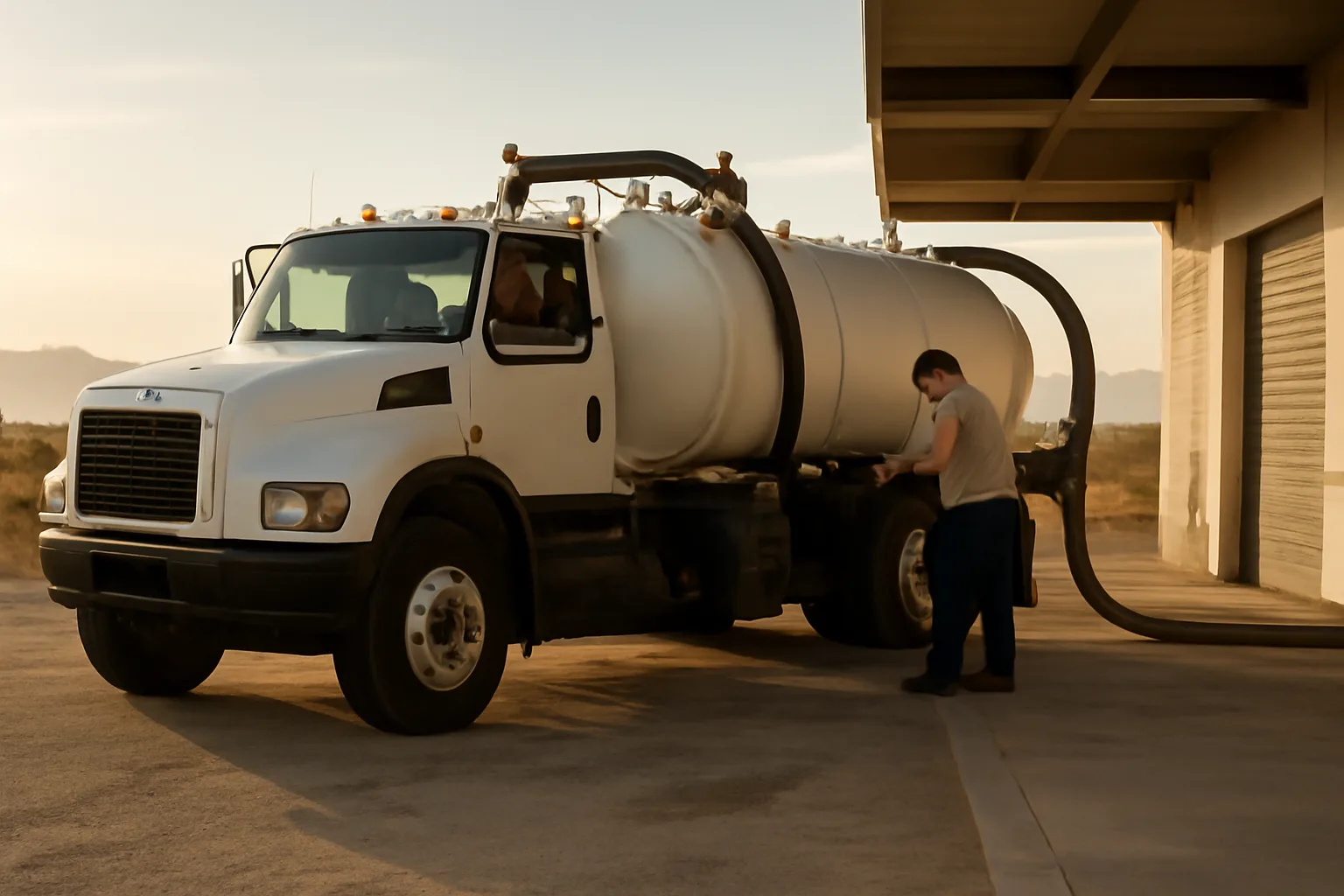
A grease trap company pulls fats, oils, and grease (FOG) out of interceptor units at restaurants, commercial kitchens, and food-processing plants. You show up with a vacuum truck, pump the trap into a sealed tank, haul the waste to an approved receiving facility, and log the whole trip on a manifest. That manifest trail is the backbone of Arizona's FOG oversight.
Restaurants are your market, and there are a lot of them. Municipal pretreatment programs in Phoenix, Tucson, Mesa, and Chandler all require regular grease trap service for food-service businesses [1]. Every commercial kitchen with an interceptor needs a licensed hauler, and many need service every 30 to 90 days.
The model is route-based. You build a list of recurring accounts, put them on a fixed rotation, and bill per service or on a monthly contract. Margins are thin with a handful of stops. An operator with 40 or more recurring stops a week can run a solid single-truck business. You scale from there.
Do you need a license for grease trap work in Arizona?
Yes. Arizona requires a Liquid Waste Contractor registration from the Arizona Department of Environmental Quality (ADEQ) before you can legally pump and transport grease trap waste [2]. Haul without one and you're facing a civil violation, with ADEQ holding authority to issue compliance orders and fines.
ADEQ's liquid waste program covers septage, grease trap waste, and other non-hazardous liquid waste moved by vacuum truck. The rules live in Arizona Administrative Code Title 18, Chapter 9, Article 3, which sets contractor registration, vehicle standards, and manifest obligations [3].
Many cities stack their own pretreatment rules on top of the state registration. Phoenix Water Services and Tucson Water each keep approved hauler lists. To dump at their treatment facilities, you have to be on those lists, and that means a separate application. Check with each city whose facility you plan to use.
You also need a standard Arizona business registration (an LLC or corporation through the Arizona Corporation Commission) and a transaction privilege tax (TPT) license from the Arizona Department of Revenue if your fees are taxable [4]. That's three separate registrations before you touch a trap.
For a closer look at what the ADEQ registration actually asks for, read our full breakdown at grease trap license in arizona.
How long does grease trap licensing take in Arizona?
Budget 60 to 120 days from a complete application to an active license number [2]. Nobody publishes a guaranteed processing time, and ADEQ's backlog moves with the season and staffing. Those are 60 to 120 days where you cannot legally haul.
The delay most applicants cause themselves is a simple one: an incomplete packet. ADEQ sends incomplete applications back, and the clock resets. Pull the checklist from ADEQ's Liquid Waste program page before you mail anything.
Vehicle inspection adds time. Every vacuum truck you plan to run has to pass an ADEQ inspection before it's approved under your license. If the truck needs repairs to pass, add those weeks. Schedule the inspection early instead of waiting for your paperwork to clear.
Municipal approvals move on their own clocks. Phoenix and Tucson approved hauler lists can take 30 to 60 extra days. If you need those to reach disposal sites, stack them on the ADEQ timeline and file both at once.
Here's the rule. Start the paperwork 90 to 120 days before you want to be operational. Do not buy the truck first and file second.
How much does starting a grease trap business cost in Arizona?
Startup costs split into three buckets: licensing fees, equipment, and working capital. A lean single-truck launch with a solid used truck runs about $26,000 to $81,000 all-in. A new-truck startup is $100,000 or more.
Licensing and registration fees
ADEQ's liquid waste contractor registration fee is set by rule and lands around $250 to $500 per year (confirm the current amount with ADEQ, since fee schedules get revised). Arizona LLC formation costs $50 through the Arizona Corporation Commission [4]. A TPT license from the Department of Revenue costs $12 [5]. Budget a few hundred dollars for city and county business licenses, which vary by jurisdiction.
Equipment: the biggest line item
The vacuum truck is the core asset. Used units in the 1,500 to 2,500 gallon range sell for $15,000 to $50,000 depending on age, mileage, and pump condition. New units from manufacturers like Vacuworx, GapVax, or Keith Huber run $80,000 to $150,000 or more [6]. Most first-timers start with a used truck in the $20,000 to $40,000 range and save the new-unit purchase for year two or three, after cash flow settles.
Add hoses, wrenches, PPE, spill kits, and a basic GPS routing app: roughly $1,500 to $3,000.
Working capital
You need cash for fuel, disposal fees, insurance premiums, and payroll (if you hire a driver) while you build your account base. Disposal fees at Arizona municipal facilities typically run $0.05 to $0.15 per gallon, though rates change by facility and waste type. Keep two to three months of operating expenses in reserve.
| Cost item | Low estimate | High estimate |
|---|---|---|
| Used vacuum truck (1,500-2,500 gal) | $15,000 | $50,000 |
| New vacuum truck | $80,000 | $150,000+ |
| ADEQ contractor registration | $250 | $500/yr |
| AZ LLC formation | $50 | $50 |
| TPT license | $12 | $12 |
| Equipment/PPE/supplies | $1,500 | $3,000 |
| Insurance (first year, est.) | $4,000 | $12,000 |
| Working capital reserve | $5,000 | $15,000 |
| Total (used truck scenario) | ~$26,000 | ~$81,000 |
These are estimates. Confirm current agency fees with the relevant office before budgeting.
What is the step-by-step process to start grease trap in Arizona?
Here's the sequence that avoids the common stumbles.
Step 1: Form your business entity. File an LLC or corporation with the Arizona Corporation Commission. An LLC costs $50 and gives you liability separation from day one [4]. Get your EIN from the IRS (free, online, ten minutes).
Step 2: Get your TPT license. File with the Arizona Department of Revenue. The $12 license covers your tax collection duties on taxable services [5].
Step 3: Apply for the ADEQ Liquid Waste Contractor registration. Download the current packet from ADEQ's Liquid Waste program page. It asks for business information, proof of insurance meeting ADEQ minimums, a list of vehicles you plan to run, and a manifest training acknowledgment. Submit it complete. Pay the fee. Wait for approval.
Step 4: Schedule vehicle inspection. Contact ADEQ to book the required inspection for each vacuum truck. Have the truck cleaned, properly labeled, and mechanically sound before the inspector shows up.
Step 5: Apply to municipal approved hauler lists. If you plan to dump at Phoenix's 23rd Avenue Water Reclamation Plant or Tucson's treatment facilities, apply to each city's approved hauler program at the same time as Step 3. Don't wait.
Step 6: Secure insurance. You need commercial auto, general liability, and pollution liability at minimum. ADEQ lists coverage minimums in the registration packet. Pollution liability is the one operators skip and then regret.
Step 7: Set up your manifest system. Arizona requires a manifest for every load you transport [3]. Your form should capture date, generator name and address, waste volume, truck ID, destination facility, and driver signature. Some operators use paper; others use software.
Step 8: Build your account base. Go after restaurant groups, commercial property managers, and healthcare facilities with kitchens. Your pitch is simple: licensed, insured, manifested, on time. Most accounts switch over reliability problems, not price.
What insurance does a grease trap business need in Arizona?
ADEQ requires proof of insurance before it approves your registration, and the specific minimums are in the application packet. Pull that document for exact figures instead of trusting a secondhand summary. The categories, though, stay consistent for this kind of operation.
Commercial auto liability covers the truck in transit. General liability covers third-party bodily injury and property damage at job sites. Pollution liability is the one that matters most here. A spill of grease trap waste on a customer's parking lot or a public street is a pollution event, and standard general liability policies exclude pollution claims. Pollution coverage is not optional in any real sense.
Expect first-year premiums of $4,000 to $12,000 depending on the truck's value, your driving history, and how much pollution coverage you carry. Get quotes from carriers that specialize in environmental contractors, not general commercial lines.
Workers' compensation is required in Arizona if you have employees [7]. If you're a solo owner-operator, confirm with a licensed Arizona broker whether you're exempt or should carry it anyway.
What equipment does a grease trap pumping business need?
The vacuum truck is the piece you cannot skip. For grease trap route work, a 1,500 to 3,000 gallon tank is common for a single operator. Small tanks (800 to 1,000 gallons) cap how many stops you run before you dump, which wrecks route efficiency. Big tanks cost more upfront and may require a CDL if gross vehicle weight tops 26,001 pounds [8].
Check the CDL question before you buy. In Arizona, a Class B CDL is required for single vehicles with a GVWR over 26,001 pounds, and a Class A CDL for combination vehicles above that line [8]. A fully loaded 2,500-gallon tank truck can hit CDL weight fast. Build licensing and testing time into your pre-launch schedule.
Beyond the truck: 4-inch and 3-inch suction hoses in 10-foot sections (30 to 50 feet minimum), a grease trap wand, pipe wrenches, a flow meter if customers bill by volume, spill containment absorbents, safety cones, PPE (nitrile gloves, apron, safety glasses, N95 respirators), and a first aid kit.
Don't skip the flow meter. Billing fights with restaurant owners almost always come down to volume. A calibrated meter with a printed ticket ends the argument before it starts.
How does the Arizona grease trap manifest system work?
Arizona Administrative Code Title 18, Chapter 9 requires a manifest for every load a liquid waste contractor transports [3]. A compliant manifest has to carry generator information, waste type and volume, transport vehicle ID, destination facility, and signatures from both the generator and the hauler.
You keep a copy. The generator keeps a copy. The receiving facility keeps a copy. ADEQ can pull manifest records during inspections. Missing or falsified manifests are a fast track to license suspension.
Some Arizona cities go further and make haulers submit manifest copies to the local pretreatment coordinator on a schedule (monthly or quarterly). Ask every city where your customers sit whether they have a separate reporting rule. A few do.
Software platforms generate compliant manifests digitally, track disposal history by account, and export records for audits. They cost $30 to $150 a month. For a 20-plus account operation, the time savings pay for it. For a five-account startup, a clean paper template works fine.
Want a ready-made manifest template and the full Arizona paperwork checklist? GreaseTrapPath's Interceptor + Manifest Kit ($199 one-time) covers both in one download at /start.
Where can you legally dispose of grease trap waste in Arizona?
Grease trap waste is non-hazardous in the regulatory sense, but it cannot go into a dumpster, a storm drain, or an unapproved septic system. Legal disposal in Arizona means one of these:
1. Municipal water reclamation facilities that take liquid waste from approved haulers. Phoenix runs the 23rd Avenue Water Reclamation Plant and the Deer Valley Water Reclamation Facility; Tucson runs its Water Reclamation Facility [10]. Each has an approved hauler program and sets its own tipping fees and acceptance hours.
2. Private rendering and recycling facilities that turn FOG into biodiesel feedstock or other products. Some pay a small credit for high-quality grease instead of charging a fee, but quality standards are strict.
3. Other permitted liquid waste receiving facilities in the region.
Never dump grease trap waste at a facility that hasn't explicitly authorized that waste type. Mischaracterizing waste at a disposal site violates state rules and potentially federal pretreatment standards under 40 C.F.R. Part 403 [9].
Confirm site availability, hours, accepted volumes, and current tipping fees before you launch. Some facilities cap volumes or require advance reservations. Building the disposal relationship early matters as much as building your customer list.
How competitive is the grease trap market in Arizona?
The Phoenix metro is competitive. Established regional players and several local owner-operators have locked up the major restaurant groups. Tucson has fewer operators and fewer accounts. Smaller markets like Flagstaff, Prescott, and Yuma run lighter on competition and make good launch points for an operator who wants to build a route without fighting for every stop.
Nobody has good published market-share data on Arizona's grease trap hauling sector. The closest proxy is the count of active ADEQ liquid waste contractor registrations, which you can request through ADEQ's public records office. Knowing how many licensed haulers work a given county tells you something about the density.
Differentiation here isn't complicated. Show up on time, leave the site clean, get the manifest to the customer the same day, and answer your phone. The accounts that switch haulers most often do it because their current provider is unreliable, not because someone came in cheaper. Price matters, but reliability matters more in a relationship where a neglected trap can trigger a city notice of violation against the restaurant.
For how neighboring states structure this business, see how to start grease trap in California and how to start grease trap in Colorado.
What are the biggest mistakes new Arizona grease trap operators make?
Buying the truck before the license is approved. This happens constantly. Someone gets excited, finds a good deal on a used vacuum truck, and buys it. Then ADEQ takes three months to process the application while the truck sits. Capital tied up, no revenue. File first, buy when approval is close.
Skipping pollution liability insurance. A 500-gallon grease spill on a restaurant's parking lot, or worse, near a storm drain, generates cleanup costs, potential fines, and a liability claim that standard general liability won't touch. The gap between the pollution premium and the cost of one spill is enormous.
Not verifying disposal site approval before the first job. Don't assume a facility that accepts liquid waste accepts grease trap waste from any hauler. Get written confirmation of your accepted hauler status at your planned disposal site before you pump a single load.
Underpricing to win accounts. The math on a route only works if you're charging enough to cover the truck note, fuel, disposal fees, insurance, and your own time. New operators price at or below established competitors, win the business, then find they're breaking even or losing money. Know your cost per gallon pumped and price above it.
Ignoring the CDL requirement. If your truck configuration needs a CDL and you don't have one, you're operating illegally the moment you leave the yard. Arizona's CDL rules are enforced by the Department of Transportation [8]. Check the weight before you finalize the purchase.
How does Arizona's grease trap startup process compare to neighboring states?
Arizona sits in the middle of the spectrum. It's more involved than states with light liquid waste oversight, but simpler than California, which layers on DTSC registration, local POTW permits, and sometimes hazardous materials disclosure depending on grease type and receiving facility.
Colorado runs a similar state contractor registration model through CDPHE, with comparable timelines. Nevada routes liquid waste oversight mostly through local health districts instead of one state agency, which can mean faster initial registration but more jurisdictional patchwork.
The manifest requirement is standard across the Southwest. What varies is enforcement. Phoenix's pretreatment program is active and audits hauler records; smaller Arizona cities may rarely inspect.
If you're picking a launch state, Arizona's unified ADEQ process is easier to map than states with fragmented county oversight. One agency, one registration, one set of vehicle inspection rules. The trade-off is that Phoenix's market is competitive enough that a new operator needs a differentiated route plan to grow fast.
See how Arizona compares to the same business in Alabama or Arkansas.
Frequently asked questions
Do you need a license for grease trap pumping in Arizona?
Yes. The Arizona Department of Environmental Quality (ADEQ) requires a Liquid Waste Contractor registration before you can legally pump and transport grease trap waste. You also need a standard Arizona business registration and a transaction privilege tax license from the Department of Revenue. Some cities require separate approved hauler status before you can use their disposal facilities. Confirm current requirements directly with ADEQ.
How long does it take to get an ADEQ liquid waste contractor license in Arizona?
ADEQ does not publish a guaranteed processing time. Budget 60 to 120 days from a complete application. Incomplete applications get returned and restart the clock. Vehicle inspections add time on top of that. Municipal approved hauler programs run on separate timelines, often 30 to 60 additional days. Start your applications 90 to 120 days before your target launch date.
How much does it cost to start a grease trap business in Arizona?
A lean single-truck launch using a quality used vacuum truck runs about $26,000 to $81,000 all-in, including the truck ($15,000 to $50,000), ADEQ registration, business formation fees, insurance, supplies, and a working capital reserve. A new truck pushes startup costs past $100,000. Confirm current ADEQ registration fees before budgeting; they change.
What type of vacuum truck do you need for grease trap work in Arizona?
A 1,500 to 3,000 gallon tank is common for single-operator route work. Larger tanks cut dump trips but may require a CDL if gross vehicle weight tops 26,001 pounds. Used trucks sell for $15,000 to $50,000; new units run $80,000 to $150,000. Check whether your planned truck configuration triggers Arizona's CDL requirement before you buy.
Do you need a CDL to operate a grease trap truck in Arizona?
It depends on the truck's gross vehicle weight rating. Arizona requires a Class B CDL for single vehicles with a GVWR over 26,001 pounds, and a Class A CDL for combination vehicles above that line. A fully loaded 2,500-gallon vacuum truck can exceed that limit. Check the truck's GVWR and loaded weight before buying and build CDL testing into your pre-launch timeline.
Where can you legally dump grease trap waste in Arizona?
Legal options include municipal water reclamation facilities with approved hauler programs (Phoenix and Tucson both run them), permitted private rendering and recycling facilities that accept FOG, and other ADEQ-approved liquid waste receiving sites. Grease trap waste cannot go into dumpsters, storm drains, or unapproved systems. Confirm your approved hauler status at the disposal site before pumping your first load.
Does Arizona require a manifest for grease trap waste hauling?
Yes. Arizona Administrative Code Title 18, Chapter 9 requires a manifest for every load transported. It must include generator information, waste type and volume, vehicle ID, destination facility, and signatures from both parties. You keep a copy, the generator keeps a copy, and the receiving facility keeps a copy. Some cities require periodic manifest submissions to their pretreatment coordinator on top of the state rule.
Do I need pollution liability insurance for a grease trap business in Arizona?
Yes, in any practical sense. Standard general liability policies exclude pollution incidents. A grease spill near a storm drain or on a customer's property is classified as a pollution event and won't be covered without a separate pollution liability policy. ADEQ's registration packet lists minimum insurance requirements. Get quotes from carriers that specialize in environmental and liquid waste contractors.
How do I get on the Phoenix or Tucson approved hauler list for grease trap disposal?
Both cities run approved hauler programs through their water or environmental services departments. Applications require proof of your ADEQ liquid waste contractor registration, current insurance documentation, and a signed agreement with the city. Apply at the same time as your ADEQ registration instead of waiting for state approval first. Contact Phoenix Water Services and Tucson Water directly for current packets and timelines.
How much can I charge customers for grease trap service in Arizona?
Rates vary by trap size, access difficulty, and frequency. Small traps (under 500 gallons) at restaurants typically run $75 to $200 per service; larger interceptors and harder-access jobs run higher. Monthly contract pricing is common for high-frequency accounts. Know your cost per gallon pumped (truck payment, fuel, disposal fees, insurance, labor) and price above it. Underpricing to win accounts is the most common first-year mistake.
Can I run a grease trap business as a sole proprietor in Arizona?
You can, but forming an LLC is the smarter move. An LLC costs $50 through the Arizona Corporation Commission and separates your personal assets from business liability. A grease trap spill or property damage claim hits the business entity, not your personal finances. The cost difference between sole prop and LLC is minimal; the liability difference is not.
What is the Arizona transaction privilege tax (TPT) and does it apply to grease trap services?
Arizona's TPT is a tax on the privilege of doing business in the state, applied to taxable sales and some services. Whether grease trap hauling falls under TPT depends on how it's classified. Register for a TPT license from the Arizona Department of Revenue ($12) and consult an Arizona CPA or tax professional to confirm whether your specific service model creates a TPT obligation.
Is the grease trap market saturated in Arizona?
The Phoenix metro has established operators and real competition. Smaller Arizona markets like Flagstaff, Prescott, and Yuma have less competition and make better launch environments for a new operator. Differentiation matters more than saturation: reliability, same-day manifests, and responsive communication win and keep accounts in any market. Request active ADEQ liquid waste contractor registration counts through ADEQ's public records office to gauge local density.
Sources
- City of Phoenix Water Services, Fats Oils and Grease (FOG) Program: Phoenix municipal pretreatment program requires regular grease trap service for food-service establishments and use of licensed haulers.
- Arizona Department of Environmental Quality, Liquid Waste Program: ADEQ requires a Liquid Waste Contractor registration before pumping and transporting grease trap waste in Arizona.
- Arizona Administrative Code, Title 18, Chapter 9, Article 3 (Liquid Waste Contractors): A.A.C. Title 18, Chapter 9, Article 3 sets contractor registration requirements, vehicle standards, and manifest obligations for Arizona liquid waste haulers.
- Arizona Corporation Commission, LLC Filing Information: Arizona LLC formation costs $50 through the Arizona Corporation Commission.
- Arizona Department of Revenue, Transaction Privilege Tax License: An Arizona TPT license costs $12 and is required for businesses engaged in taxable sales or services.
- U.S. Small Business Administration, Manage Your Finances: Equipment costs are a primary capital expense for service startups and vary widely based on new versus used purchases.
- Industrial Commission of Arizona, Workers' Compensation for Employers: Workers' compensation insurance is required in Arizona for businesses with employees.
- Arizona Department of Transportation, Commercial Driver License: A Class B CDL is required in Arizona for single vehicles with a GVWR over 26,001 pounds; Class A for combination vehicles above that threshold.
- U.S. EPA, National Pretreatment Program, 40 C.F.R. Part 403: Mischaracterizing waste type at a disposal facility violates federal pretreatment standards under 40 C.F.R. Part 403.
- City of Tucson Water, Industrial Waste and Pretreatment Program: Tucson Water operates a pretreatment program requiring approved hauler status for grease trap waste disposal at its treatment facilities.